SHARP-EATMAN
NATURE
PHOTOGRAPHY
ID GUIDE TO WILD BEES - NEW YORK

SQUASH BEES
Genus Xenoglossa
Squash Bee
(Xenoglossa)
Squash bees evolved in tandem with squash plants, which are native to the Americas. These wild bees are specialist pollinators – they visit cucurbits, that is, squashes, pumpkins, gourds and melons. The bees’ geographical range coincides precisely with the range of such plants.
Although domestic honey bees also visit squash blossoms, squash bees are such efficient pollinators that they can pollinate all of a squash plant's open flowers by early morning, before honey bees brought in as crop pollinators reach the blossoms. Squash bees are exceptional pollinators of zucchini and butternut squashes.
Squash bees are unusual because of their ability to fly through the dark in order to arrive on host plants before sunrise. A squash bee's ocelli -- its three small simple eyes located between its two compound eyes – are enlarged for this purpose. Squash bees begin their daily feeding early because squash flowers tend to wilt by mid-afternoon.
Squash bees are excellent pollinators for other reasons. They are fast fliers, and thus able to visit more flowers per day than honey bees. Squash bees are also large and hairy; their hair collects pollen, and the bees' size guarantees more surface area to which pollen can stick. These last qualities make even male squash bees excellent pollinators: as they visit flowers to sip nectar, they transfer pollen from one blossom to the next, enabling reproduction and fruit formation.
Squash bees emerge from overwintered nests in spring to feed on the nectar of squash blossoms. Initially, both males and females sleep in the flowers. After mating, females dig as deeply as 1 1/2 feet into the soil, forming tunnels with side-burrows leading to cells in which the females deposit eggs. Thereafter, the females overnight in their nests. During the day, females collect and carry pollen back to the nest, provisioning the egg cells for the next spring when the young hatch. The bees then seal off the cells and die. After the larvae hatch, they overwinter in their nests, feeding on the pollen provisions left there. In early summer, the larvae metamorphose into bees and sally forth into the warm air just before squash plants begin flowering.
At Stone Barns, squash bees are prevalent in plantings of winter squash and zucchinis. During growing season, the bees can be seen flying from one orange squash blossom to another, or hanging head downwards inside the flowers, their striped abdomens pointing upwards. When the squash blossoms wither under the afternoon sun, the males crawl inside them to sleep; if you uncurl a wilted winter squash or zucchini flower at Stone Barns, more often than not you’ll find a squash bee sleeping there.
Squash bees are preyed on by the cuckoo bee Triepeolus remigatus. (This bee is shown in the photo strip here and also appears in the cuckoo bee section of this guide.) Triepeolus remigatus cuckoo bees creep into squash bee nests and deposit eggs there. When the cuckoo larvae hatch, they kill off the squash bee larvae and eat the provisions stored for them in the nest.
Squash bees are reportedly in decline, in part because of their sensitivity to commercial pesticides. Their specialized function as early morning squash pollinators also makes them vulnerable; they forage sparingly and less competitively on other plants. Notably, the bees do not inhabit Rockefeller Park State Preserve, which lies adjacent to Stone Barns but has no squash or melon plantings. Nevertheless, the preserve, which partly surrounds Stone Barns, serves the important function of shielding the bees from exposure to pesticides.

A squash bee (Xenoglossa pruinosa) bathed in the yellow light filtering through a squash blossom

Squash bees are said to have "big noses," because the fronts of their faces are blunt and protuberant. Males, like the one shown here, have a light-colored spot on the clypeus (the face-part above the mandibles). On females, the clypeus is black.

Squash bees' long tongues enable them to collect pollen and nectar from deep-throated flowers.

A male squash bee sticking out its tongue in a flower inhabited by several bees.
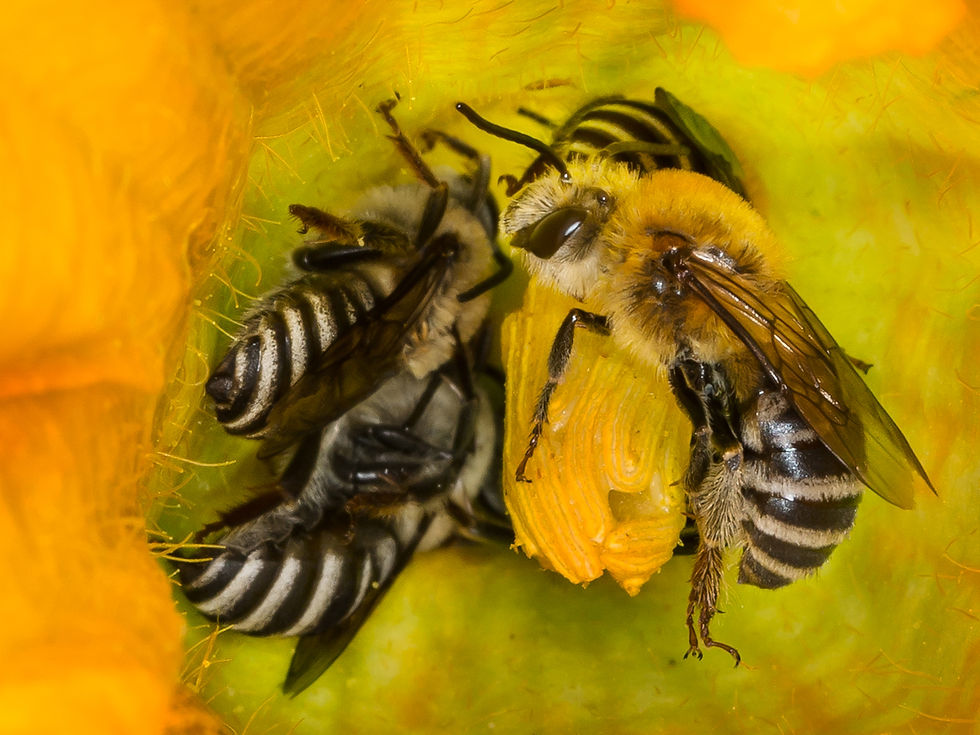
It is not unusual to find multiple squash bees inside a squash blossom. The bee on the right is female, and the rest are sleeping males.

This is a typical sight inside a squash blossom -- squash bees with their striped abdomens pointed upwards and their heads buried in a flower.

The small dark eye between this squash bee's antennae is one of its three ocelli. Ocelli are simple eyes positioned between bees' two large compound eyes. Squash bees' ocelli enable them to navigate in the dark.

A squash longhorn cuckoo bee (Triepeolus remigatus), nectaring on a blue cornflower. This species deposits eggs in the nests of Xenoglossa pruinosa.
Squash blossoms
at dawn
A squash bee bathed in the yellow light of a squash blossom


Squash Bee
(Xenoglossa pruinosa)
Size: 12.5-14 mm (female)
511-13 mm (male)
Identification Information: Squash bees are about the size of a typical honey bee. They somewhat resemble honey bees in form, but hoary squash bees are more robust and hairier and have abdomens striped with boldly-defined bands of pale hairs. Squash bees' thoraxes are covered with light rust-orange hairs. Their legs are black with reddish lower segments, and their wings are glassy yellow with black veins. Both males and females have protuberant lower faces (clypei), and black eyes and antennae.
Squash bees of the species Xenoglossa pruinosa are also referred to by the common names "hoary squash bee," "pruinose squash bee" and "eastern cucurbit bee". The genus Xenoglossa belongs to the bee tribe Eucerini, also known as longhorn bees. There are more than thirty genera of Eucerini in all. Another is Melissodes longhorn bees, shown in this guide's next section.
Squash bees range from southern Canada through Central America into South America. There are approximately 10 species in the United States, although squash bee taxonomy is currently in a state of flux. The hoary squash bee until recently was called Peponapis pruinosa. In 2023, a comprehensive phylogenic study of the longhorn bee tribe Eucerini resulted in Peponapis being reclassified as a subgenus within the genus Xenoglossa (Freitas et al. 2023).
The hoary squash bee can be told apart by similar squash bees of its genus by traits of the clypeus: the female's all-black face and the small pale spot over the male's clypeus, shown in the accompanying photo strips, are distinctive. Xenoglossa pruinosa is the single squash bee species found in New York State.
Taxonomy of Squash bees
Order: Hymenoptera
Family: Apidae
Subfamily: Eucerinae
Tribe: Eucerini (Long-horned Bees)
Genus: Peponapis
Subgenus: Peponapis
Species: Xenoglossa pruinosa


A male hoary squash bee (Xenoglossa pruinosa): males have a distinctive pale spot on the "nose" (on the clypeus, part of the lower face). This trait helps greatly in identifying them.

A male hoary squash bee drinking nectar from wild bee balm (Monarda fistulosa).

Although this species is a squash pollinator specialist, males often drink nectar from tubular flowers in late afternoon after squash blossoms have wilted.

A female pruinose squash bee

Face of a female hoary squash bee: females have dark faces, without pale markings. Note the yellow pollen sticking to the bee's facial hairs.
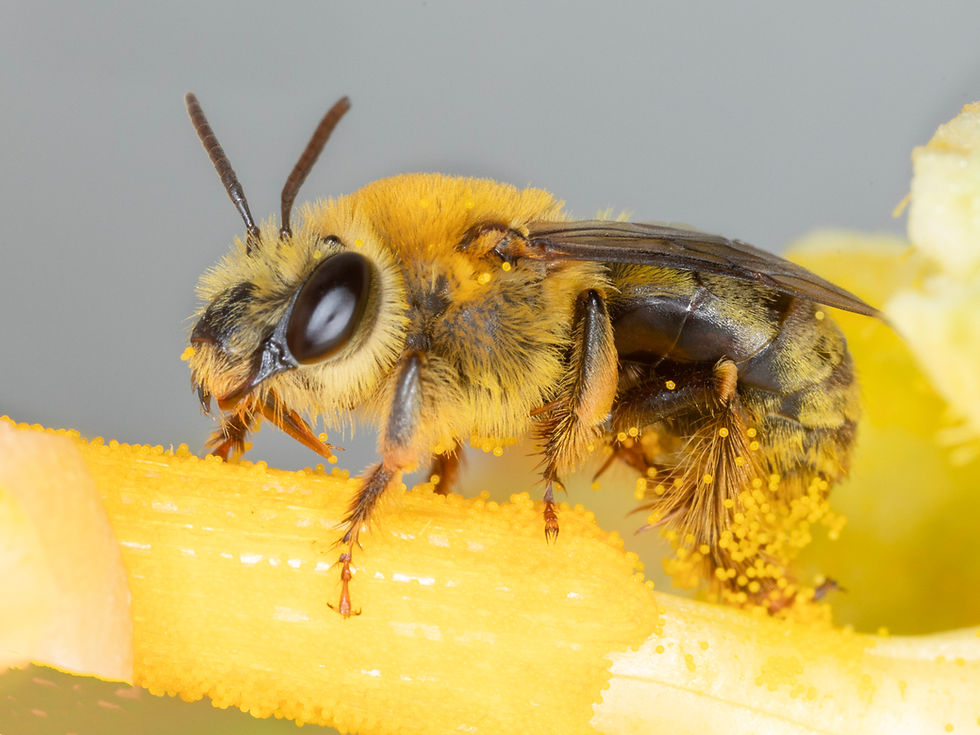
Lateral view of female: note the protuberant clypeus.