SHARP-EATMAN
NATURE
PHOTOGRAPHY

BUMBLE BEES have plump, furry-looking, yellow-and-black bodies and are known for the loud buzzing sound they make when they zoom by. Bombus, the genus to which bumble bees belong, means "buzzing" or "deep roar" in Latin. Bumble bees practice buzz pollination, using vibrations of their flight muscles to shake pollen from flower anthers. This makes them particularly effective pollinators of crops such as tomatoes, peppers and eggplants.
Bumble bees are visible in New York from March through November. They build their nests underground or slightly above the ground. Like honey bees, bumble bees tend to be social. That is, they form multigenerational colonies that contain a queen, male drones and female workers. Bumble bee colonies are more modest in size, however, than honey bee hives. While honey bee colonies may may contain tens of thousands of bees, bumble bee nests usually harbor a few hundred workers at most.
In March and April in our area, bumble bee queens surface from hibernation and scout for good nesting sites, often selecting holes abandoned by small rodents. The queens sustain themselves on nectar from early-flowering trees such as willow and redbud. They collect pollen as they go, to bring back to their nests for storage. The queens construct wax eggs cells in their nests and deposit eggs in them. From these, pupae hatch that gradually metamorphose into winged workers, which emerge to gather pollen for the hive. Thereafter, the queens may remain home, laying more eggs and producing successive new generations of workers. Usually around mid-summer, the queens nurture specially-fed offspring that develop into males and new queens. After mating, the males die, along with the worker bees. The queens alone survive to brave the winter and re-emerge in the spring.
Many bumble bee species are currently in decline in New York and other states, a result of habitat loss and pesticide use. There are currently nine bumble bees on the New York Natural Heritage Program Rare Animal List. Among these is the yellow bumble bee, shown below, which appears in both the park and Stone Barns in early and mid-summer.
A female brown-belted bumble bee
Brown-belted Bumble Bee
(Bombus griseocollis)
Size: 10-22 mm (2/5" - 9/10 in.)
Brown-belted bumble bees are important pollinators of blackberries, raspberries, stone fruits, wildflowers and garden flowers. These bees appear in sun-filled grassy fields and swampy areas of Rockefeller State Park Preserve, particularly where milkweed abounds. The males of this species like to perch on plants and chase moving objects in search of mates. Males prefer high perches and, according to the bumble bee experts Williams, Thorp, Richardson and Colla, authors of the classic Bumble Bees of North America, male brown-belted bumble bees have been sighted near the top of the Empire State Building.
Identification Information: These bees can be best identified by their trim "crew cut" fur and by the belt of brown hair that usually appears near the front end (on the second segment) of their black abdomens, just behind a narrow yellow band. Brown-belted bumble bees have black legs and dark transparent wings. Their heads are black, sometimes with yellow markings, and they have large black eyes. The bees' thoraxes are yellow-haired; the scutum (first thorax segment) often has a bald black area edged with black hairs. Queen bees may lack the brown belt. Queens are substantially larger than other members of this species but have the same distinctive large eyes and trim fur.
Unlike other bumble bees shown on this page, brown-belted bumble bees have short tongues. They thus are unable to access nectar and pollen from deep-throated flowers. They prefer blossoms that have flat landing platforms containing multiple florets, such as black-eyed Susans and thistles. Instead of expending energy by flying from one flower to the next, brown-belted bumble bees can walk from floret to floret, efficiently gathering a small amount of nectar from each. The brown-belted bumble bees shown here were gathering nectar in this fashion from coneflowers, common milkweed and swamp milkweed. These bumble bees also feed on goldenrod, toadflax and thistles along park trails and in Stone Barns' gardens. They first appear in our area in mid-March and remain throughout the summer.


Brown belted bumble bees have a characteristic rust-colored strip just under the first yellow band of their abdomens.

A brown-belted bumble bee on milkweed. These bees have large eyes and trim "crewcut" fur on their thoraxes.

This is a queen common eastern bumble bee. She lacks the brown belt but still shows the characteristic trim fur of this species.
Common Eastern Bumble Bee
(Bombus impatiens
Size: 8 mm-20 mm (1/3 to 4/5 in.)
Common eastern bumble bees are found throughout Rockefeller State Park Preserve and Stone Barns. In mid-summer, these bumble bees can be seen in large numbers gathering pollen from milkweed in sunny clearings of the park and from coneflowers in the Visitor's Center garden. When together, the bees make an impressive buzzing noise as they zoom from flower to flower. Common eastern bumble bees, however, do not swarm and are not aggressive. They tend to ignore the presence of people and to appear fully absorbed by the work of gathering pollen.
Common eastern bumble bees are exceptionally hardy. They are among the first bees to appear in the park in early spring, when there is still a chill in the air. Queen common eastern bumble can be spied zipping though the park's woodland areas in the first weeks of April. Bombus impatiens workers are the most numerous bumble bee pollinators of the park's May-blooming Peony Monument garden and of the park's summer wildflowers and Visitor's Center summer garden.
In late August, other bumble bee species in our area begin to fade -- but common eastern bumble bees forge on in significant numbers. These tough bees linger in the park glades as summer flowers give way to goldenrod, thistles and asters. During this period, common eastern bumble bees negotiate a transformed habitat, skirting adult crab spiders that lie in wait in fall flowers for pollinators. Bombus impatiens are among the last bees to disappear in fall -- they can be spied as late as early November, pollinating the last scraggly asters still blooming as winter sets in.
It is also notable that in our area, during periods of drought when many bee populations dwindle and disappear from view, Bombus impatiens forge on. They can be spied on the hottest, driest summer days, wrestling with the blossoms of toadflax and other weeds.
Common eastern bumble bees are generalist pollinators that visit a seemingly endless list of flora. At Stone Barns Center for Food and Agriculture, these bees appear wherever flowers and vegetables are in bloom -- they can be seen pollinating crops as diverse as sunflowers, tobacco, eggplants, clover and summer squash, foraging among herbs like lavender and comfrey, and drinking nectar from a diverse gamut of garden flowers.
The common eastern bumble bee is an essential pollinator of many commercial crops, among them blueberries, cranberries, tomatoes and peppers. This hardy bee is also a vigorous pollinator of urban gardens.
Identification Information: The common eastern bumble bee is a gold-and-black- bee, with a black head; a thorax usually covered in pale-gold hairs with a patch of black hairs at the center; and an abdomen covered with pale-gold hairs on the fiirst segment and black on all other segments. These bees vary greatly in size: males can be more than twice the size of the smallest female workers, which can measure as little as one third of an inch.
Bombus impatiens morphs: Occasionally, morph common eastern bumble bees appear that manifest color variation. Instead of having abdomens striped with black hairs, the morphs have dark reddish brown hairs. A short discussion of this phenomenon can be found at bugguide.net. An example of a morph Bombus impatiens is shown in the photo strip here.

A female common eastern bumble bee with orange salvia pollen in its pollen baskets

A female common eastern bumble bee
A crab spider capturing a common eastern bumble bee

A common eastern bumblee bee

This is a common eastern bumble bee worker on a blue cornflower: from behind, the bee looks predominantly black. Its thorax and the top segment of its abdomen are covered with pale yellowish-brown hairs.

This female (worker) common eastern bumble bee is gathering pollen from blue lobelia. Bumble bees carry pollen in corbiculae, or baskets, located on their hind legs. Corbiculae are made of tiny interwoven leg hairs.

Two-Spotted Bumble Bee
(Bombus bimaculatus)
Size: 10-20 mm (2/5 -4/5 in.)
Two-spotted bumble bees tend to live close to or within wooded areas. They are less commonly seen at the park and Stone Barns than the other bumble bees shown here. Nevertheless, two-spotted bumble bees do sally forth from the woods in early spring, around the time the first cherry trees bloom. These wild bees are thought to have a co-evolutionary relationship with many short-lived spring wildflowers. Bombus bimaculatus queens are the chief pollinators of Dutchman's breeches, a spring ephemeral that emerges in April in the park.
Beginning in mid-June, two-spotted bumble bees can be spied foraging amid wild thistles in the Swan Lake meadow and feeding on sage in Stone Barns' herb gardens. Two-spotted bumble bees are generalists, known to pollinate a variety of wildflowers and garden flowers, including bee balm, sweet clover, goldenrod, St. John's Wort, honeysuckle, roses and rhododendrons. These bees are also documented pollinators of stone fruits, blackberries, raspberries, blueberries and linden trees. Two-spotted bumble bees disappear from the park in mid-July.
Identification information: Two-spotted bumble bees look yellow from a distance: they have predominantly yellow-haired faces and thoraxes (mid-sections). They have wide, plump-looking bodies, and their hair is thick and flush. Their legs, eyes and antennae are black, and their wings are transparent dark brown. As shown in the photo strip here, the first segment of a female two-spotted bumble bee's abdomen is yellow, and the second is black on the sides, with a patch of yellow arranged around the mid-line on the top of the bee. (In males, the first two segments are occasionally yellow, followed by a yellow -intermixed-with -black segment.)
Two-spotted bumble bees can be best identified by the rounded W-shape of the curved line formed where the yellow hairs of the front abdominal segments meet the black hairs of the segments behind them.
The name "two-spotted" can be confusing, as the spots on this bee can be difficult to locate. Some sources hold that there are "two yellow spots" on the bee's abdomen (located approximately where the W's curves lie); other sources maintain that there are "two black spots," a contradiction that serves as a testament to the need to give this bee a better name.
The scutum (first thorax segment) of the two-spotted bumble bee usually has a small patch of black hairs at the center. This is a good way to distinguish Bombus bimaculatus from the perplexing bumble bee, which has an entirely yellow thorax; and from the golden northern bumble bee, which has a black bar crossing its thorax. Two-spotted bumble bees are sometimes mistaken for half-black bumble bees; the differences between these two species are noted below.

A worker two-spotted bumble bee
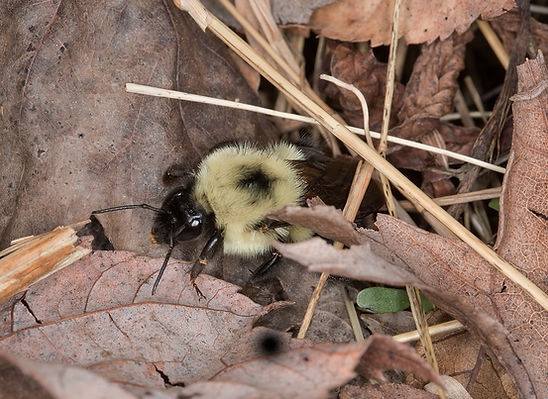
A queen two-spotted bumble bee emerging from her nest in early spring

A female two-spotted bumble bee: note the characteristic rounded W where the bee's yellow hairs meet the darker hairs of the abdomen.

A female two-spotted bumble bee, showing a characteristic second abdominal segment that is yellow in the middle and black on the sides.

A male two-spotted bumble bee. Two-spotted bumble bee males tend to be slightly larger than their female counterparts (up to 3/5 inches). All male bumble bees have 7 abdominal segments while females have 6, although this fact is often obscured behind the bees' furriness. In addition, male bumble bees have 13 segments on their antenna; females have 12.

In very early spring, queen two--spotted bumble bees pollinate this woodland flower, known as dicentra or Dutchman's brreches.

This is a queen two-spotted bumble bee, outside her nest in March, 2016. Her nest is in a chipmunk hole in the ground, hidden under leaves and under woodland debris.

The queen digs through the debris to enter her nest.
Half-black Bumble Bee
(Bombus vagans)
Size: 15-20 mm (3/5-4/5 in.)
Half-black bumble bees' preferred natural habitats are woodland areas and wetlands. These bees emerge in May at the park, foraging on the flowers of woodland trees. During the spring and summer, half-black bumble bees can be spied only occasionally in sunny areas of the park, feeding on wineberry blossoms, toadflax, St. John's wort, thistles, milkweed, heath aster, staghorn sumac and goldenrod. Unlike many bees, half-black bumble bees like to forage in shady woods. Perhaps in part because of this, they may be harder to spy in the park than many of the other bumble bees shown on this page.
Half-black bumble bees are somewhat easier to encounter at Stone Barns, where they hover around cover crops like cow vetch and clover. The bees are also drawn to sunflower plantings and to flowering herbs in Stone Barns' gardens, among them tansy, beebalm, hyssop, various catmints and betony. Half-back bees are also documented pollinators of rhododendrons, cranberries and melons.
Half-black bumble bees build fairly small colonies, numbering around seventy bees. Like most bumble bees, they build nests in holes in the ground, or occasionally above ground. In our personal field experience, these are tough little bumble bees. We have seen them grab larger common eastern bumble bees from below and behind by their back legs and yank them off flowers, tumbling them in the same way you might yank to the ground someone standing above you on a ladder.
Identification information: Half-black bumble bees are most easily identified in profile. The yellow portion of the bee -- its thorax and the first two segments of its abdomen -- extends a long way down the bee's body, like a yellow tunic. The half-black bumble bee's thorax is yellow-haired on the top and sides, usually with a cluster of black hairs at the center of the scutum (the first thorax segment). The hairs of the half-black bumble bee are fairly long and frequently described as "shaggy-looking". The underside of the bee is black; its legs are black; and its wings are somewhat dark. Males have yellow hair on their faces, and both males and females have yellow hair on the upper sides of their heads.
These are small bumble bees, compared to several others on this page. Half-black bumble bee workers tend to run 2/5" to 1/2" in length; males are slightly larger. Queens may be longer, up to 4/5". The female bee shown here is about 3/4" and probably a queen.

A female half-black bumble bee

The half-black bumble bees is most easily identified in profile -- yellow hairs on the bee's thorax and the first two segments of its abdomen form a yellow tunic that extends more than half the length of the bee's body.

A line with a curved W shape is formed where the yellow hair of half-black bumble bee's top two abdominal segments meets the black hair of the third abdominal segment, Because of this, seen from behind, half-black bumble bees can be confused with two-spotted bumble bees. The half-back bumble bee, however, can be distinguished by the fact that both of its first two abdominal segments are yellow, followed by an all-black third segment.

Half-black bumble bees have extravagant, shaggy hair, as shown here. Note also the tuft of yellow hair at the top of the bee's head, which is characteristic of the species. This bee's antennae show that she is a female: the antennae of female bumble bees have 12 segments, while those of the males have 13.