SHARP-EATMAN
NATURE
PHOTOGRAPHY

LONGHORN BEES
Tribe Eucerini - Genus Melissodes
Melissodes belong to the longhorn bee tribe Eucerini and have unusually long antennae – hence the name longhorn. Eucerini serve as essential pollinators for multi-million-dollar crop industries. They include, among others, Xenoglossa squash bees, key pollinators of melons and squash; and Melissodes longhorn bees, highly efficient pollinators of sunflowers and cotton. Melissodes are also irreplaceable pollinators of gardens and native flora.
Melissodes behavior:
In southern New York, Melissodes tend to appear from June through August. All Melissodes are ground-nesters. The bees burrow holes in the earth, where they construct individual nests containing brood cells, sometimes lined with a waxlike material, each cell typically holding one egg and a single pollen ball. The nests, which may be isolated or built close to one another, are often hidden under brush. Thus, Melissodes are most easily spotted while away from their nests, foraging on flowers for nectar and pollen. Males sleep outside, and often can found together in early morning, sleeping on plants in groups called aggregations.
Traits of the tribe Eucerini and the Genus Melissodes
In his 992-page book, The Bees of the World, entomologist Charles D. Michener described Eucerini as hairy bees, which often have abdomens banded by pale hairs. On the typical Eucerini, the top of the head is nearly flat, a trait useful in distinguishing longhorn bees from bees of other tribes.
The genus Melissodes is the largest member of the tribe Eucerini. It is found only in the Western Hemisphere, where it ranges from Canada to southern South America. There are approximately 140 Melissodes species, currently divided into five subgenera.
According to Theodore B. Mitchell, author of the 1,100 page, two-volume work, Bees of the Eastern United States, all Melissodes have these defining characteristics: (1) the clypeus (the lower face-part above the mandibles) is dark on females and usually pale or partly pale (yellow or white) on males; (2) females have feathery scopal (pollen-collecting) hairs on their hind legs; (3) males have longer antennae than females, and (4) males have toothlike spines projecting from the sides of their 7th abdomen segment.
Other minute but useful ID traits of both male and female Melissodes include the following: (1) On the antennae, F1 (the third segment from the bottom) is much shorter than F2 (the segment above it); and (2) On the forewing, there are three submarginal cells. The second cell is always shorter than the third, and usually shorter than the first. The third cell is always longer than it is wide.
All of these traits are illustrated in the accompanying photo strip.
Species appearing in this guide
The genus Melissodes is represented in this guide by three different subgenera comprising six different species.
Of the six species shown here, five are pollinator specialists -- that is, they typically visit one kind of plant or group of plants. Melissodes apicatus visits pickerelweed and little else. Melissodes denticulatus emerges when ironweed begins to bloom and feeds principally on ironweed. Melissodes agilis and M. trinodis are associated with sunflowers and similar aster-family flowers. Melissodes desponsus is a thistle pollinator.
The two-spotted longhorn bee, Melissodes bimaculatus, is the single species shown here that is a broad generalist, feeding on plants from many different families.

A female dark-veined longhorn bee (Melissodes trinodis)

A male ironweed longhorn bee (Melissodes denticulatus)
TRAITS OF MELISSODES LONGHORN BEES

This is a female Melissodes longhorn bee. Females are robustly built, hairy bees.

Females have feathery scopal (pollen-collecting) hairs on their hind legs.

Dorsal view of the hind-leg scopal hairs of a Melissodes female.

Female Melissodes have relatively short antennae.

Male Melissodes have narrower builds than females and long antennae. They lack the bushy hind-leg scopal hairs typical of females.

Most Melissodes have dark abdomens that are banded. The bands are formed by pale hairs.
Taxonomy of Melissodes species
appearing on this guide page:
Order: Hymenoptera
Family: Apidae
Subfamily: Eucerinae
Tribe: Eucerini (Longhorn bees)
Genus: Melissodes
Subgenus: Apomelissodes
Species: Melissodes apicatus
Subgenus: Eumelissodes
Species: Melissodes agilis
Melissodes denticulatus
Melissodes desponsus
Melissodes trinodis
Subgenus: Melissodes
Species: Melissodes bimaculatus
Pickerelweed Longhorn Bee
(Melissodes apicatus)
Subgenus Apomelissodes
Size: 11-14 mm (females)
10-13 mm (males)
This is the single Melissodes species on this page that has not been documented recently at Rockefeller State Park or in the surrounding Westchester County, New York. We include this species here in the hopes that regional naturalists will seek it out to record it.
Melissodes apicatus is a pollinator specialist of pickerelweed (Pontederia cordata), a plant that roots in the shallow water of marshy areas. Pickerelweed is a showy wildflower – it grows up to four feet high, with blossoms arranged on long bluish-purple spikes. It is native to New York, where it blooms from June through September.
The pickerelweed longhorn bee is documented relatively rarely, but is nonetheless widespread –- it is found throughout eastern North America, from Florida to Maine. It has been recorded in various New York locations – as far south as Long Island and as far north as Oswego – and it appears in neighboring states such as Connecticut, Vermont and Pennsylvania.
The pickerelweed longhorn bee is underreported in part because it often feeds away from shore in marshlands, far from the eye of the casual naturalist. Nonetheless, it is notable that pickerelweed grows along the banks of marshlands as well as in them -- it even crops up in roadside drainage ditches. Hence, a casual naturalist or photographer can approach pickerelweed flowers closely enough to view bees feeding on them.
If you find this species anywhere in New York, please report your discovery through a public database such as iNaturalist or Bugguide.net.

A pickerelweed blossom: pickerelweed flowers are bluish purple and grow on spikes.

The leaves of pickerelweed are long and pointed. Flower stalks tend to grow close together in shallow marsh water.
The subgenus Apomelissodes
Melissodes apicatus is a member of the subgenus Apomelissodes. Longhorn bees of this subgenus have protuberant lower faces, and the bands on the bees' abdomens are positioned along the outer edges of the segments. This second trait is uncommon among Melissodes.
Species description of Melissodes apicatus:
The prefix “api-“ means “apex” or “tip,” and refers to the defining trait of the subgenus -- on the pickerelweed longhorn bee, pale bands of hair line the rims of the abdomen's segments. These apical bands stand out in the field: they produce a pattern of crisply defined, broad white stripes alternating with a dark hairs.
Detailed traits: Both male and female pickerelweed longhorn bees have blue or blue-green eyes, protuberant brownish-black clypei and black labrums (the lower facial parts directly above and behind the mandibles). Females' mandibles are black, with yellow near the tips. On both males and females, pale hairs cover most of the face and head. On both, a dense fringe of dark hairs covers part of the vertex (top of the head, behind the small simple eyes called ocelli.)
Males' faces vary greatly in appearance, as shown in the accompanying photo grid: males may have mostly black faces, with small yellow spots on the clypeus, or their clypeus may be almost entirely yellow -- or anything in between. Such variation in male facial markings is somewhat unusual in Melissodes.
Both male and female pickerelweed longhorn bees have hairy heads and thoraxes. The scutum and scutellum (1st and 2nd thorax segments) are covered with dense, chocolate-brown hairs ringed by pale hairs. Both males and females have glassy wings with smoky-brown outer edges.
Both males and females have white and brown hairs on their legs. On females, there are patches of dark hairs on the outer front and mid tibiae. Females' hind-leg scopal hairs are creamy-white and relatively short and weakly branched. They are less feathery in appearance than is typical of Melissodes generally.
Biology: Melissodes apicatus are solitary bees that are known to nest in sandy soils -- but they may nest in other soil types as well. There is little published information about their behavior.
A recent study conducted in Gainesville, Florida, suggests that Melissodes apicatus are capable of nesting far from marshes containing pickerelweed, making their nest sites difficult to find.
The Gainesville pickerelweed longhorn bees constructed burrows deep under a layer of sandy soil in a Florida sandhill habitat located nearly half a mile from the nearest pickerelweed. The bees' nests had no visible entry portals -- instead, they "swam" through many inches of sand before reaching their underground tunnels. Their nest area was thus invisible to passersby.
Associated cuckoo bees: The cuckoo bee species Triepeolus rugosus was observed entering the nests of Melissodes apicatus in Florida. In the northeastern United States (Massachusetts), Triepeolus obliteratus has been linked to Melissodes apicatus nests.
Other floral associations: Floral visitation records for Melissodes apicatus are limited. Although they have been documented feeding nearly exclusively on pickerelweed, both males and females have been recorded feeding on hedgenettle (Stachys) and thistle (Cirsium). There are records of males visiting white sweetclover (Melilotus alba) and pink evening primrose (Oenothera speciosa).

A female pickerelweed longhorn bee (Melissodes apicatus)
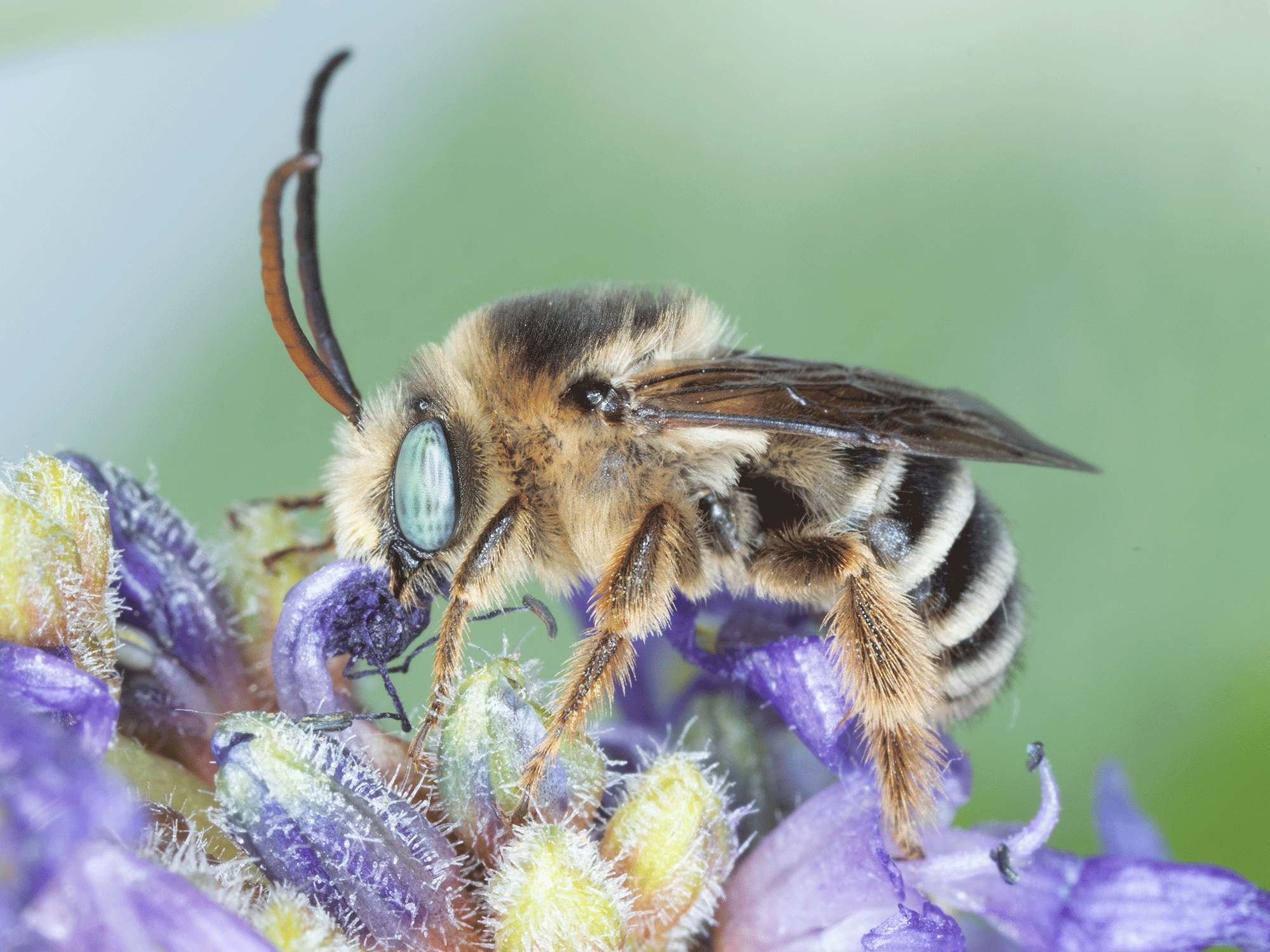
A male pickerelweed longhorn bee (Melissodes apicatus)
TRAITS OF FEMALE & MALE MELISSODES APICATUS

This is a female pickerelweed longhorn bee (Melissodes apicatus).

The bee's clypeus is protuberant.

The female's face is brownish black and partly covered with white hairs.

A male Melissodes apicatus (pickerelweed longhorn bee)

Males' abdomens have four pale apical bands (T2-T5).

The apical bands are broad and aligned with the back rim of each segment. There are dark hairs between the bands.

The faces of 8 male pickerelweed longhorn bees found at a single nest site
in Florida: such facial variation is unusual in Melissodes. The last picture
shows a female: female Melissodes apicatus have entirely black faces.

A female Melissodes apicatus diving headfirst into the ground
in order to "swim" through the sand to her burrow below
Ironweed Longhorn Bee
(Melissodes denticulatus)
Subgenus Eumelissodes
Size: 9.5-11 mm (female) 9-11 mm (male)
The subgenus Eumelissodes
Charles D. Michener wrote in The Bees of the World that Eumelissodes is the largest and most abundant subgenus of its genus. Eumelissodes contains roughly 70 of the approximately 140 known Melissodes species. Bees of this subgenus are found throughout North and Central America, from Canada to Panama and Cuba. Most longhorn bees of New York belong to the subgenus Eumelissodes.
Michener described Eumelissodes as medium-sized bees (8-16 mm) with banded abdomens. Females have feathery scopal hairs on their hind legs. Males' clypei tend to be yellow or white and not especially protuberant; the male's labrum varies in color. (The clypeus is the face-part above the mandibles, and the labrum is right below the clypeus).All of the Eumelissodes on this guide page -- Melissodes denticulatus, M. agilis, and M. trinodis and M. desponsus -- can be recognized in part by these traits.
Eumelissodes may be either broad generalist pollinators or specialists that focus on particular plant genera or families. Many Eumelissodes favor large-flowered plants within the Asteraceae family such as sunflowers, daisies, blanketflowers, and coneflowers. Others specialize on specific aster-family plants such as ironweed or thistles.

A female Melissodes denticulatus flying through giant ironweed

Blossoms of giant ironweed
The Ironweed longhorn bee (Melissodes denticulatus)
Melissodes denticulatus is a specialist pollinator of ironweed (Vernonia), a plant with deep purple flowers, native to New York, where it blooms from late July through August. Most of the bees shown here were found gathering nectar from New York ironweed (Vernonia noveboracensis), or giant ironweed (Vernonia gigantea).
If you live in New York and plant ironweed in your yard, it is highly likely to attract ironweed longhorn bees within the plants' first blooming season. This is well worth the effort, as Melissodes denticulatus are attractive bees and entertaining to watch. Both males and females are fast fliers, zipping from one ironweed bloom to the next, at a speed nearly too fast for the eye to follow. Females pack white ironweed pollen in large loads on their hind legs. Even two or three stalks of giant ironweed (which grows to twelve-feet tall), can attract dozens of these bees.
Despite its specialist pollinator status, Melissodes denticulatus is known to visit an array of other flora, particullarly when ironweed is not available. In all specialist bee species, males are particularly likely to visit nonspecialist plants, partly because males visit flowers only for nectar and do not gather pollen. Melissodes denticulatus have been documented foraging on aster-family flowers such as black-eyed Susan, cornflower, and goldenrod, as well as flowers from other families, among them penstemon, squashes and mints. The female bees shown here were all found on ironweed, but the males were discovered on garden oregano and Joe Pye Weed as well as ironweed.
Species Identification information:
When viewed in flight, Melissodes denticulatus have a gray or silvery appearance. They are relatively small for longhorn bees, between 9 and 11 mm (1/3-2/5 in.). Both the female and male Melissodes denticulatus have a black thorax covered with pale and grayish-brown hairs; a black abdomen striped with pale hair bands; transparent brown wings with dark veins; and striking bluish-gray eyes.
Females are robustly built and have feathery yellowish scopal hairs on their hind legs. Their legs appear bright white when laden with ironweed pollen. Females' faces are darkly colored, and their antennae are shorter than males'. Females' antennae are dark brown and black, and their mandibles are dark with reddish areas near the tips.
ID tips: Females can be distinguished from most other regional Melisssodes by this minute trait: there are scattered dark hairs on the pronotal lobes (plates near the front of the thorax). This trait is shown in the accompanying photo strip.
Head and thorax: The head and thorax of the female are usually covered with a combination of light and dark hairs that produce a silvery effect. There is considerable variation in hair color, however -- some individual females have all light or all dark hairs on the thorax or vertex (the top of the head, behind the small eyes called ocelli). Females typically have at least some light hairs on the sides of the thorax (the mesepisternum).
Abdomen: On the female's abdomen, the white hair bands on T2 and T3 are set back from the rim. The hair band on T4 that is closest to the rim is either white or white with a patch of dark hairs in the center.

A female ironweed longhorn bee (Melissodes denticulatus)

A male ironweed longhorn bee (Melissodes denticulatus)
TRAITS OF FEMALE & MALE MELISSODES DENTICULATUS

This is a female ironweed longhorn bee (Melissodes denticulatus).
Female Mellissodes denticulatus are small but robustly-built. They have an overall gray appearance, and feathery light-gold scopal hairs on their hind legs.

Females have dark faces, dark antennae and blue-grey eyes. The female's mandibles are black, sometimes with reddish tips. The female's clypeus (face-part above the mandibles) is black.

A male Melissodes denticulatus

This male was found feeding on garden oregano in late July, 2026, along with 30+ other male bees. The bees appeared together on the oregano for appoximately a week.

Additional view of male bees cavorting on oregano

A male ironweed longhorn bee with asymmetrical facial markings
Males: Male ironweed longhorn bees' blue-gray eyes make them stand out in the region -- most male Eumelissodes of New York have green eyes. The male's mandibles are black or reddish black, sometimes with yellow at the tips -- but always without pale markings near the base. The antennae of male Melissodes denticulatus are black behind, and brown or reddish brown in front above the third segment (above F1).
ID tips: Males are most easily identified by traits of the clypeus and labrum, which are both distinctive. (The clypeus is the face part right above the mandibles, and the labrum is the part below the clypeus).
The male's clypeus is a typically a creamy white (not yellow or light yellow), with a jagged-edged dark area invading it from above. Males show notable variation in the size and shape of the dark area. (An example of unusual marking on a male's clypeus is shown in the accompanying photographs.) The bee's labrum is black, or black with a pale spot in the middle.
Head and thorax: The hairs on the male bee's vertex are either entirely white, or white mixed with dark hairs. The thorax is covered with a mixture of dark and light hairs.
Abdomen: The bands of hair on T2 and T3 are set back from the rim. On T2, and on T4, the hairs between the pale band and the rim may be either light or dark.
Sunflower Pollinators:
Subgenus Eumelissodes
Dark-veined Longhorn Bee
(Melissodes trinodis)
Size: 10-11 mm (female)
9-11 mm (male)
Agile longhorn bee
(Melissodes agilis)
Size: 10.5-15 mm (female)
9-12 mm (male)
The dark-veined longhorn bee (Melissodes trinodis) and the agile longhorn bee (Melissodes agilis) are both known for their prowess as sunflower pollinators. These two species can be found energetically visiting sunflower patches and fields in New York throughout July and August.
Sunflowers are particularly attractive nectar and pollen sources for bees. A sunflower is actually a collection of tiny flowers -- each sunflower blossom consists of many tightly-packed tubular florets filled with pollen and nectar. A single sunflower may have hundreds of florets. This structure allows bees to move efficiently from one pollen source to another without between-blossom flights. The broad landing pad of a sunflower also provides a place where bees can rest between pollen-gathering stints.
Dark-veined and agile longhorn bees often commingle in groups of several female bees spread across the large surface of a single sunflower. Males can be found flying rapidly from one sunflower to the next, patrolling for mates, and rarely alighting in one place for long. In late evening, males gather to overnight on the sunflower heads. In early morning, they often can be found sleeping together in groups called aggregations, their faces tucked into the sunflower petals.
Melissodes trinodis and M. agilis are specialist pollinators of flowers in the family Asteraceae, also known as composites. When sunflowers are not available, these two species commonly visit large-flowered composites such as coneflowers, blanketflowers, coreopsis and daisies.
Geographical range of Melissodes trinodis & M. agilis
Agile longhorn bees are widespread -- they range from coast to coast, as far north as Montana and Ontario, and as far south as the Mexican state of Coahuila. Dark-veined longhorn bees, on the other hand, are most heavily concentrated in the eastern half of the United States. They range through the Midwest and are found as far west as Idaho, Colorado, New Mexico and Texas. They occur in Mexico as far south as San Luis Potosi and Jalisco.
Bee Behavior
Melissodes trinodis: Relatively little has been written in the last 120 years about the behavior of Melissodes trinodis. In 1905, entomologist Sigmund Graenicher briefly described a Wisconsin Melissodes trinodis nest. He linked the longhorn bee to the cuckoo bee species Triepeolus helianthis, which he observed entering the nest.
Triepeolus are cleptoparasites that deposit their own eggs in the egg cells of host bees such as Melissodes. When the cuckoo larvae hatch, they kill off the host eggs or larvae and devour provisions stored by the longhorn bee host for its own offspring. Individual Triepeolus species often target only one or two host species -- a specific cuckoo bee and its targeted longhorn host are thus said to be "linked" to one another.
Graenicher described the Melissodes trinodis nest as a shallow and alternately vertical and sloping burrow that led to thimble-shaped egg cells half filled with “bee bread” derived from pollen. The egg cells were formed of hardened clay with a smooth and polished inner surface.
Graenicher detailed in colorful language the behavior of Triepeolus helianthis larvae as they “crawled lively around the smooth wall of the cell," making biting movements with their large, curved mandibles and chomping on the bee bread and the dead larval bodies of Melissodes trinodis and other less fortunate Triepeolus.
Melissodes agilis: Because M. agilis is the most common and widespread sunflower pollinator of the United States, several studies have been published about this species. The most thorough was a 1981 article by entomologists Parker, Tepedino & Bohart, who described the species’ nesting behavior.
Tepedino et al. discovered that Melissodes agilis nested very close to their food source – constructing their burrows inside sunflower fields and nearby irrigation ditches. Their nests consisted of vertical tunnels that connected to multiple radiating lateral tunnels. These led to egg chambers whose walls were coated with a waxlike substance. The researchers discovered the same cuckoo bee species within the cells that Graenicher had discovered in Wisconsin 76 years earlier entering Melissodes trinodis nests -- Triepeolus helianthis.
General traits of Melissodes trinodis & M. agilis
Both Melissodes agilis and Melissodes trinodis are medium-sized bees with heads and thoraxes covered with pale gold to rust-orange hairs. The bees' abdomens are banded by pale hairs. Females have feathery scopal hairs on their hind legs, and males have white or yellow clypei and long antennae.
Dark-veined vs. agile longhorn bees
Dark-veined longhorn bees (Megachile trinodis) and agile longhorn bees (Melissodes agilis) can be very difficult to tell apart. In New York and other northeastern states, individual specimens of both species show great variability and often share characteristics of both species.
As an example: male Melissodes trinodis of the Midwest often have all-black mandibles, a trait that allows them to be easily separated from M. agilis males, whose mandibles have prominent yellow spots at the base. In New York, and much of the Northeast, however, M. trinodis males frequently have mandibles with yellow spots at the base.
Some individual specimens from New York clearly show the hallmarks of either Melissodes trinodis or M. agilis -- such specimens can be identified to species. In many cases, however, where specimens have traits of both species, the best option is to identify specimens as "either Melissodes trinodis or M. agilis".
Detailed traits of Melissodes trinodis & M. agilis
FEMALES:
Melissodes trinodis and M. agilis females share these traits: The female's clypeus and antennae are dark. Its head and thorax are covered entirely, or nearly entirely, with light-colored hairs. The female's vertex (top of head) is typically covered with light or rust-colored hairs. The female's feathery hind-leg scopal hairs are pale-gold on the outer hind legs, and partly rust-colored and brownish-black on the inner hind legs. T2 and T3 (2nd & 3rd abdomen segments) are banded by pale hairs set back from the rim.
Females of the two species differ as noted below:
Melissodes trinodis - female: (1) The wing veins are black or brownish-black. (2) The hairs on the female's vertex and thorax are often rust colored. There are sometimes scattered dark hairs on the vertex, or small areas of dark hair on the top and sides of the thorax (scutum, scutellum & mesepisternum). (3) The rims of T2-T4 are dark brown. (4) The hair on T4 is usually partly or entirely dark, but may also be entirely light.
Melissodes agilis - female: (1) The female's wing veins are red or reddish brown (not dark brown or black). (2) The hairs on the female's vertex and thorax are usually pale-gold and only sometimes rust-colored. All hairs on the vertex and thorax are almost always entirely light, without any dark hairs. (3) The rims of T2-T4 are transparent or a translucent light brown (not dark brown). (4) The hair on T4 of M. agilis is entirely pale or straw-colored rather than dark.
MALES
Melissodes trinodis and M. agilis males share these traits: Males have green eyes, and a bright yellow clypeus with a narrow brown strip along the lower rim. All hair on the male's head, thorax and legs is light colored (not black or brown). Face and thorax hair may be pale-gold to bright rust-colored. T2 and T3 have pale hair bands set back from the rim of the segment.
Males of the two species differ as noted below:
Melissodes trinodis - male: (1) The wing veins are brown or dark brown. (2) The thorax hair is usually rust-colored, but may be pale-gold. (3) The rims of T2 and T3 are dark brown. (4) On T4, the hairs near the rim of the segment may be either pale or dark (black or brown). (5) The mandibles often appear entirely dark, without a yellow spot at the base, especially in the Midwest and western United States. In the Northeast, mandibles are more likely to have a yellow spot at the base. Mandibles may be reddish or even yellowish toward the tips. (6) The male's labrum (face part below the clyepus) is black, sometimes with a yellow spot at the base.
Melissodes agilis - male. (1) The wing veins are light yellow to pinkish or peach. (2) The vertex and thorax hair are usually off-white to pale-gold, but may be rust-colored. (3) The rims of T2-T3 are transparent and colorless or a translucent light brown. (4) On T4, the hairs near the rim of the segment, if present, are pale (without brown hairs). (5) The mandibles typically have yellow spots at the base. They may be yellowish toward the tips. (6) The male's labrum is most yellow, with black edges on the sides.

A male agile longhorn bee (Melissodes agilis)

An ideal habitat for Eumelissodes -- the Stone Barns dooryard gardent replete with large-flowered Asteraceae: Melissodes trinodis and M. agilis are frequent visitors.


A female dark-veined longhorn bee (Melissodes trinodis)

A male agile longhorn bee (Melissodes agilis)
TRAIS OF A TYPICAL FEMALE MELISSODES TRINODIS

This photo strip shows a typical Melissodes trinodis female.

This bee has glassy wings with dark brown veins. This trait is the best way of differentiating this species from the very similar Melissodes agilis.

Alternate view of wings
TRATIS OF A TYPICAL MALE MELISSODES AGILIS

This is a fairly typical male Melissodes agilis.

This male has wings with light-pink veins, pale-gold hair covering its thorax and vertex, and a banded abdomen.

Close-up of the male bee's wings.
QUICK IDENTIFICATION TRAITS:
MELISSODES TRINODIS
WINGS: Wings have brownish-black veins.
THORAX & HEAD HAIR: Thorax and vertex frequently are covered with rust-colored hairs & sometimes have pale-gold hairs.
ABDOMEN RIMS: Abdomen segments T2-T3 have dark brown rims.
ABDOMEN HAIRS: Hairs on T4 (on both males and females) are often at least partly dark brown.
FEMALES - thorax: There may be some dark hairs on the vertex and thorax.
MALES - mandibles: Mandibles are often entirely dark, without a yellow spot (especially outside of the Northeast).
QUICK IDENTIFICATION TRAITS:
MELISSODES AGILIS
WINGS: Wings have yellowish or pink veins in males & dark red or brownish veins in females.
THORAX & HEAD HAIRS: Thorax & vertex frequently are covered with off-white or pale-gold hairs & sometimes have rust-colored hairs.
ABDOMEN RIMS: Abdomen segments have transparent or light-brown rims.
ABDOMEN HAIRS: Hairs on T4 (on both males and females) are entirely pale.
FEMALES - thorax: There are no dark hairs on the vertex and thorax.
MALES - mandibles: Mandibles always have a yellow spot at the base.
Eastern Thistle Longhorn Bee
(Melissodes desponsus)
Subgenus Eumelissodes
Size: females: 12-13.5 mm
males: 11-13.5 mm
As its common name implies, Melissodes desponsus is a specialist pollinator of thistles. It is easily recognized by its dogged association with thistles, combined with its distinctive appearance -- it is a black bee with a mane of golden hairs.
In southern New York, Melissodes desponsus emerges in July and August when thistles are in bloom. The bees' dependence on thistles makes their continued existence in some environments precarious -- since thistles tend to be weeded from gardens and groomed landscapes. Other efficient pollinators, such as bumble bees and honey bees, also forage on thistles and compete for their pollen and nectar.
Late summer in New York is a period prone to drought. Because thistles are fairly drought-resistant, many bee species turn to them when other food sources dry up. Thus, competition among bee species can be particularly fierce during the very season when thistle longhorn bees are flying. Without an abundance of thistles in a habitat, thistle longhorn bees often struggle for survival during dry summers.
Outside of nature preserves, thistle longhorn bees are most likely to be found in the hardscrabble environments that escape weeding -- in vacant lots and untended fields, and along road shoulders, railroads and power line accessways.
Perhaps because there is little economic interest in thistles, there are no detailed published studies of this species' nesting behavior. Like Melissodes generally, eastern thistle longhorn bees are solitary and nest in the ground. Evidence suggests that Melissodes desponsus nests are sometimes invaded by the cuckoo bee Triepeolus donatus.
Females overnight in their nests, but male Melissodes desponsus sleep above ground. Males often can be found in groups in early morning, clinging by their mandibles to plant stems. They also sometimes sleep in thistles, their heads buried deeply in the flowers, with only the tips of their abdomens showing.
Thistle longhorn bees forage at times on plants other than thistles. Males tend to emerge slightly earlier in the summer than females, sometimes shortly before thistles bloom. Some of the males here were found drinking nectar from ironweed and clematis just as thistles in the area were beginning to open. The females shown here were found feeding on field thistle (Cirsium discolor).

Description of Melissodes deponsus
Melissodes desponsus is a robustly-built black bee with light-gold hair on its thorax, and an abdomen covered nearly entirely by black hairs. The bee’s largely black abdomen sets it apart from most other northeastern longhorn bees, which tend to have abdomens banded by pale hairs. The hind legs of female Melissodes desponsus have feathery pale-gold scopal (pollen-collecting) hairs.
The female eastern thistle longhorn bee has a dark face and black mandibles with prominent orange spots at the tips. The female's clypeus is black. (The clypeus is the lower-face part, right above the mandibles.) On the male bee, the mandibles are black and the clypeus is primarily white. The male's clypeus typically has a narrow brown edge on the outer (lower) rim, and narrow black margins on the sides and base, but individual specimens vary and may have black patterns invading the central white area.
Females and males differ somewhat in the distribution of light hairs on their heads and bodies. Females' faces typically have light hairs around the antennae, but dark hairs cover the rest of the face. On males, light hairs may cover the front of the face, the cheeks and top of the head -- although there is considerable variation among individual males; on some, the same face parts may be partly or mostly covered with dark hairs.
Females' thoraxes are usually covered with mostly pale hairs on the upper half and darker hairs on the lower half of the mesepisternum (sides of thorax). On males, most of the thorax is typically covered with pale hairs, with dark hairs appearing on the bottom border of the mesepisternum and the underside of the thorax. The proportion of light and dark thorax hairs, however, varies considerably among individual male specimens.
On females and most males, most of the abdomen is either bare or covered with black hair -- except for a small fringe of longish pale hairs on the base of the first segment (T1). On some males, there are interrupted bands of short pale hairs on T2-T3, usually confined to the sides of the segments. Less commonly, females may show faint traces of similar bands.
The front and middle legs of the female thistle longhorn bee are covered with black hairs. All of the male's legs are entirely black, except on the inner surfaces of the lower hind legs (basitarsi), which sport pale hairs.
Identification tips:
Most of the longhorn bees shown on this page currently belong to the subgenus Eumelissodes -- including the eastern thistle longhorn bee (Freitas et al. 2023) Not long ago, however, Melissodes desponsus was considered a member of the small subgenus Heliomelissodes, which had only two bee members worldwide.
According to entomologist Charles D. Michener, bees of the subgenus Heliomelissodes could be recognized by the distinctive qualities of their faces: the clypeus is protuberant and the male's labrum is black. These traits are still useful in separating eastern thistle longhorn bee from many other Melissodes species. (The labrum is the face part between the mandibles, directly below the clypeus.)
In addition to these characteristics, the following traits help distinguish Melissodes desponsus from similar species:
Females: Female Melissodes desponsus can be told apart from similar Melissodes by these minute traits: (1) the nearly entirely black hairs on the abdomen; (2) the presence of black to dark-brown hairs on the inner surfaces of the female's hind basitarsi (lower legs); and (3) the prominent orange spots on the tips of the mandibles.
Male: Male M. desponsus can be told apart from similar Melissodes by: (1) the largely black abdominal hairs; (2) the predominantly black leg hairs; (3) the black labrum, which is covered with black hairs; and (4) minute traits of the antennae, detailed below.
In the northeastern United States, Melissodes desponsus is most easily confused with Melissodes dentiventris, another longhorn bee with a largely black abdomen and pale-gold thorax hairs. This species usually can be ruled out because it is uncommon and not particularly associated with thistles.
Female Melissodes desponsus and M. dentiventris can be easily distinguished because the latter lacks the prominent orange spots on the mandibles found on Melissodes desponsus.
Males can be distinguished by this minute trait: on the male M. desponsus, F1 (the third antennal segment) is clearly longer than the pedicel (the second antennal segment). In addition, the leg hairs of the male M. dentiventris are mostly yellowish rather than black.

A female eastern thistle longhorn bee (Melissodes desponsus)

Dorsal view of a female eastern thistle longhorn bee (Melissodes desponsus)

A male eastern thistle longhorn bee (Melissodes desponsus)

A male eastern thistle longhorn bee with unusual facial markings
TRAITS OF FEMALE & MALE MELISSODES DESPONSUS

The female Melissodes desponsus is a black bee with blond hairs on its face and thorax and bushy pale-gold scopal hairs on its hind legs.

Frontal view of female bee: note the pale-gold hairs covering the face in the area around the antennae.

Females have distinctive orange spots on the tips of their mandibles.

A male eastern thistle longhorn bee

Male eastern thistle longhorn bees have pale gold thorax hairs, black abdomens and legs covered with predominantly black hairs.

Close-up of male's head and thorax: the hairs are pale on the vertex (the top of the head behind the small simple eyes called ocelli).
Two-spotted Longhorn Bee
(Melissodes bimaculatus bimaculatus)
Subgenus Melissodes
Size: 13-15 mm (female)
11-13 mm (male)
The subgenus Melissodes (Melissodes)
The two-spotted longhorn bee belongs to the nominate subgenus Melissodes (Melissodes). This is a relatively small group within the United States, comprised of about 11 species. Charles D. Michener defined Melissodes (Melissodes) by qualities of the males: they typically have pale labrums and their long antennae usually reach to the back rim of the first abdomen segment and often farther. (The labrum is the lower face-part, located bethind the mandibles.) Bees in this subgenus are small to medium-sized, from 7.5 to 15 mm (3/10-3/5 in.).
The two-spotted longhorn bee
Melissodes bimaculatus are beautiful coal-black bees -- so dark that on sunny days, it is difficult to discern more than the bees' dark silhouettes when they land on brightly-colored flowers. On closer inspection, Melissodes bimaculatus have black-haired bodies, black wings, dark antennae, and greenish-blue eyes. Females' hind legs are adorned with ostentatious, feathery pale-gold scopal (pollen-collecting) hairs,
Unlike all other Melissodes featured on this guide page, two-spotted longhorn bees are generalist pollinators that forage on a wide range of flora. They have been documented visiting flowers of more than sixty different plant families.
Two-spotted longhorn bees are one of the three most important pollinators of cotton. (The other two are honey bees and common eastern bumble bees.) They are also significant pollinators of other commercial crops, including corn, asparagus, beans, peas, cucumbers, melons, and squash. They are reportedly more efficient pollinators of watermelon than honey bees.
In addition to being versatile and energetic pollinators, Melissodes bimaculatus show extraordinary adaptability. They are a common sight in natural areas and semi-urban and urban areas wherever flowers abound. A retired former Director of Rockefeller State Park Preserve photographed two-spotted longhorn bees in 2026 pollinating squash in a rooftop Manhattan garden.
In New York, two-spotted longhorn bees are important pollinators of hardscrabble wildflowers such as dandelions, thistles and the beautiful blue chicory that grows throughout the state along highway road shoulders. Melissodes bimaculatus are also a common sight in flower gardens -- among other flora, Melissodes bimaculatus visit aster-family standards such as cosmos, coneflowers, coreopsis and daisies; evening primrose; gaura; hibiscus; mint-family plants such as monarda and salvias; petunias; portaluca, morning glories, and most common garden herbs. Two-spotted longhorn bees are often the first pollinators to arrive in gardens during early morning.
Melissodes bimaculatus also have a long flight season – from late May to September in New York, and from April to October in the southern United States. This species’ tolerance of both hot and cool weather and its flexibility in habitat and floral choice have insured its wide range: two-spotted longhorn beans occur throughout the East, from Ontario to Florida – and they are found as far west as Idaho, Colorado and New Mexico. From there, they range southward into Mexico.
Subspecies of Melissodes bimaculatus
Melissodes bimaculatus is divided into two subspecies. Melissodes bimaculatus bimaculatus is the subspecies found in New York and throughout most of the species' range. The description below is for Melissodes bimaculatus bimaculatus.
A second subspecies, Melissodes bimaculatus nulla occurs in Florida. This subspecies is generally somewhat larger and darker; females have black, brown or yellowish orange (rather than pale) hind-leg scopal hairs. On male Melissodes bimaculatus nulla, the outer surfaces of the legs are covered with black or brown hairs.
Identification information
Female Melissodes bimaculatus bimaculatus are black bees with black hairs covering most of the head, thorax, abdomen and legs, and with pale scopal hairs on their outer hind-leg tibiae.
On females, there are two spots on the fourth segment of the abdomen (T4), formed by dense pale hairs (hence the name "two-spotted longhorn bee"). These hairs are positioned where many longhorn bee species have pale hair bands – but on the female two-spotted longhorn bee, the T4 hair band is broadly interrupted in the middle, so that only its lateral edges bear pale hairs.
On many female two-spotted longhorn bees, there are also pale hairs on T2 or T5, but these are not plentiful or dense enough to be perceived as spots. Most hairs appearing on the female's abdomen are black. On the female, pale hairs are mostly confined to the hind leg tibiae, and to a scattering of light hairs on the face and around the antennae.
Females have black faces. Their mandibles are reddish black, sometimes with yellowish tips. Their antennae are black behind and brownish-black in front above F1 (the third antennal segment).
The female two-spotted longhorn bee might be mistaken for the eastern thistle longhorn bee shown above. The two species can be fairly easily distinguished by the following: the thistle longhorn bee's thorax is covered with light hairs, and this species is usually associated with thistles.
Male Melissodes bimaculatus bmaculatus are slightly smaller and less robustly-built than females. They have very long antennae and greenish-blue eyes. On males, the clypeus (the face part above the mandibles) and the labrum (the part below the clypeus) are yellowish-white. The mandibles usually have a pale spot at the base. Males' antennae are black behind and reddish in front above F1 -- to the naked eye, the antennae often have a strong reddish cast.
Like the females, males are black bees with dark wings and with black hairs covering most of the head, thorax and abdomen. Males, however, have striking pale hairs on the middle and hind legs; these hairs commonly cover the outer tibiae and tarsi (the 4th and lower leg segments). This feature varies considerably among individual males --- some have more or less extensive pale hairs covering the legs.
Most males have at least some white hairs on their heads and bodies, although this trait varies among individual bees. Typically, there are pale hairs on the male's face and vertex (top of the head); and dark hairs mixed with light hairs on the top and sides of the thorax (the scutum and mesepisternum).
Males also sometimes have pale hairs on the abdomen, on the base of T1. They sometimes have narrow, widely interrupted bands on T3-T5 -- however, these lack the dense white hairs that create the effect of "spots" on the females.

A female two-spotted longhorn bee (Melissodes desponsus)

A male two-spotted longhorn bee (Melissodes desponsus)

Rear view of a female two-spotted longhorn bee (Melissodes desponsus)
TRAITS OF FEMALE & MALE MELISSODES BIMACULATUS

This is a female two-spotted longhorn bee. Females' bodies, heads and legs are covered with predominantly black hairs. Their hind legs have pale, feathery scopal hairs.

Female Melissodes bimaculatus have black faces -- the female's clypeus, mandibles and antennae are all darkly-colored. Females' eyes are dark blue-gray or greenish-blue.

The female Melissodes bimaculatus has two pale markings on the rear of its abdomen. These are formed by dense hairs on the lateral edges of the fourth abdomen segment.

This is a male Melissodes bimaculatus. Males have narrower builds and long reddish antennae.

Black hairs cover most of the male's body, but parts of the male's head and thorax are covered with pale hairs. The tibia and basitarsi of the male's middle and hind legs are covered with white hairs.

Hair color on males' legs varies among individual bees. On some males, there are more extensive white hairs on the middle legs. There may be white or light-brown hairs on the foreleg tibia and basitarsi.
Nesting biology. Melissodes bimaculatus are solitary ground-nesting bees that often build nests close by one another in groups called aggregations. Until recently, little was known about the species' nesting behavior, but a recent study revealed that their aggregations may be exceptionally large.
In 2024, entomologists James Giulian, Bryan N. Danforth and Jordan G. Kueneman released a study of a vast aggregation of two-spotted longhorn bees occupying a 2400 square meter residential lawn in Albany County, New York. The aggregation was the largest reported in Melissodes history – the researchers estimated its annual emergent population at more than half a million bees.
Giulian et al. recorded for the first time many interesting details of Melissodes bimaculatus behavior (among them, females' proclivity for grass pollen). An intriguing facet of the bees' behavior involved their relationship with the cuckoo bee Triepeolus simplex.
Triepeolus are cleptoparasites that enter Melissodes nests to deposit eggs in brood cells housing Melissodes eggs. When the cuckoo larvae hatch, they destroy the longhorn bee eggs or larvae and feed on provisions left by the Melissodes hosts for their own young. Melissodes engage in a variety of strategies to deter Triepeolus: for example, they hide their nests under vegetation, or engage in labor-intensive practices such as inserting plugs near nest entrances, or filling burrows leading to egg chambers with dirt.
Guilian et al. hypothesized that the Albany County Melissodes bimaculatus aggregation employed a "selfish herd" strategy to defend itself from Triepeolus simplex. Selfish-herd behavior essentially occurs when members of a group reduce their individual risk by jockeying for positions that place others between themselves and danger.
Bees on the outer edges of the vast Albany aggregation were most likely to cover and hide nests. Those in the center of the aggregation were more likely to forgo such defensive strategies, possibly because they were insulated by an outer ring of defense. Nest density was also greater in the center of the aggregation -- indicating competition for choice, internally-located nest spots.
Male bee behavior
Giulian et al. were the first researchers to document the association between Melissodes bimaculatus and Triepeolus simplex. Previously, nesting two-spotted longhorn bees had been linked only to the cuckoo species Triepeolus lunatus.
As is true of Melissodes generally, female two-spotted longhorn bees overnight in their nests, whiles males sleep and roost outside, usually on plants. Male Melissodes bimaculatus often can be found in early morning, sleeping in aggregations on plants.
A recent study by Harms & Owens (2025) documented male two-spotted longhorn bees returning to the same roost sites several years in a row, and sometimes sharing them and sleeping side by side with Triepeolus lunatus.
Recommended References
Cresson, Edward Townsend. 1879. Catalogue of North American Apidae. Transactions of the American Entomological Society 7: 215-232.
Freitas, Felipe V., Michael G. Branstetter, Vinícius H. Franceschini-Santos, Achik Dorchin, Karen W. Wright, Margarita M. López-Uribe, Terry Griswold, Fernando A. Silveira, & Eduardo A.B. Almeida. UCE phylogenomics, biogeography, and classification of long-horned bees (Hymenoptera: Apidae: Eucerini), with insights on using specimens with extremely degraded DNA. Insect Systematics and Diversity 7(4).
Giulian, James, Bryan N. Danforth, & Jordan G. Kueneman. 2024. A large aggregation of Melissodes bimaculatus (Hymenoptera: Apidae) offers perspectives on gregarious nesting and pollination services. Northeastern Naturalist 31(3): 403–418.
Graenicher, Sigmund. 1905. Some observations on the life history and habits of parasitic bees. Bulletin of the Wisconsin Natural History Society 3: 153-167.
Harms, Kyle E., & Brittany E. Owens. 2025. Backyard bees: multi-year fidelity to a sleeping roost site by male Melissodes bimaculatus (Lepeletier) (Hymenoptera: Apidae) and co-roosting by parasitic Triepeolus lunatus (Say) (Hymenoptera: Apidae) in southeastern Louisiana. Journal of the Kansas Entomological Society 98: 30-39.
Hogland, Frank E. 2025. The Melissodes Project. https://themelissodesproject.wildref.org/index.html [Highly recommended for detailed information on Melissodes agilis, M. apicatus and M. desponsus.]
LaBerge, Wallace E. 1963. New species and records of little-known species of Melissodes from North America (Hymenoptera: Anthophoridae). Bulletin of the University of Nebraska State Museum 4(10): 227–242.
LaBerge, Wallace E. 1961. A revision of the bees of the genus Melissodes in North and Central America. Part III (Hymenoptera, Apidae). The University of Kansas Science Bulletin 42(5): 283–663.
LaBerge, Wallace E. 1956a. A revision of the bees of the genus Melissodes in North and Central America. Part II (Hymenoptera, Apidae). The University of Kansas Science Bulletin 38(8): 533–578.
Lovell, J.H., & T.D.A. Cockerell. 1906. Notes on the bees of southern Maine: Anthophoridae, Halictoididae, Macropidae and Panurgidae. Psyche 13(1): 109–113.
Melissodes trinodis. Maryland Biodiversity Project. https://www.marylandbiodiversity.com/species/3328
Michener, Charles D. 2007. The Bees of the World [2nd Edition]. Johns Hopkins University Press; Baltimore, MD; xv+953 pp.
Mitchell, Theodore B. 1962. Bees of the Eastern United States. Volume II. North Carolina Agricultural Experiment Station Technical Bulletin No. 152.
Parker, Frank D., Vincent J. Tepedino, & George E. Bohart. 1981. Notes on the biology of a common sunflower bee, Melissodes (Eumelissodes) agilis Cresson. Journal of the New York Entomological Society 89: 43–52.
Robertson, Charles. 1901. Some new or little-known bees. The Canadian Entomologist 33: 229–231.
Robertson Charles. 1897. North American bees−descriptions and synonyms. Transactions of the Academy of Science of St. Louis 7(14): 315–356, at 355.
Sharp, Paula & John B. Pascarella. 2026. Nesting biology of Melissodes apicatus and its brood parasite Triepeolus rugosus (Hymenoptera: Apidae), with the first host record and description of the male parasite. Journal of Melittology. Forthcoming.
Smith, Frederick. 1854. Catalogue of Hymenopterous Insects in the Collection of the British Museum, Part II, Apidae. London: Taylor and Francis.
Veit, Michael F., John S. Ascher, Joan Milam, Frederick R. Morrison, & Prentice Z. Goldstein. 2021. A checklist of the bees of Massachusetts (Hymenoptera: Apoidea: Anthophila). Journal of the Kansas Entomological Society 94(2): 81–157. [Linking Triepeolus obliteratus to Melissodes apicatus]
Wright, Karen, Kelly B. Miller, & Ho-jun Song, 2020. A molecular phylogeny of the long-horned bees in the genus Melissodes latreille (Hymenoptera: Apidae: Eucerinae). Insect Systematics & Evolution 52(4): 428–443.