SHARP-EATMAN
NATURE
PHOTOGRAPHY

STELIS CUCKOO BEES (Painted Dark Bees)
Tribe Anthidiini - Genus Stelis
Like the leafcutter cuckoo bees (Coelioxys) shown in this guide's preceding section, Stelis are cuckoo bees belonging to the bee family Megachlidae.
Stelis are small-to-moderate sized bees (4-14 mm), with coarsely-pitted bodies that are usually black, and sometimes dark metallic blue or green. Stelis often have yellow, white or reddish-orange markings on their heads, thoraxes, abdomens or legs. The cuckoo bees' common name "painted dark bees" derives from this trait. Stelis females lack pollen-collecting (scopal) hairs under their abdomens because, like other cuckoo bees, they do not gather pollen but instead rely on the pollen stores of their hosts.
Stelis have the following traits typical of their tribe Anthidiini: they have forewings with two submarginal cells and arolia on their feet. Arolia are pad-like parts situated between the bee's tarsi -- they act like suction cups, allowing bees to climb vertical surfaces.

A female Stelis (Dolichostelis) louisae (Louisiana painted dark bee)
Stelis behavior
Stelis usually target the nests of other bees of the family Megachilinae, among them members of the tribes Osmiini, Megachilini, and even their own tribe, Anthidiini. Stelis cuckoo bees enter the nests of their hosts to lay eggs. When the Stelis larvae hatch, they destroy the host's eggs or larvae and eat pollen stores left by the host parent for its own offspring.
TAXONOMY OF STELIS CUCKOO BEES
shown on this guide page:
Family: Megachilidae
Subfamily: Megachilinae
Tribe: Anthidiini
Genus: Stelis
Subgenus: Dolichostelis
Species: Stelis Louisae
TRAITS OF STELIS CUCKOO BEES

This is a Stelis cuckoo bee of the subgenus Dolichostelis. One common name for Stelis is "painted dark bees," because they are often black with brightly-colored markings.
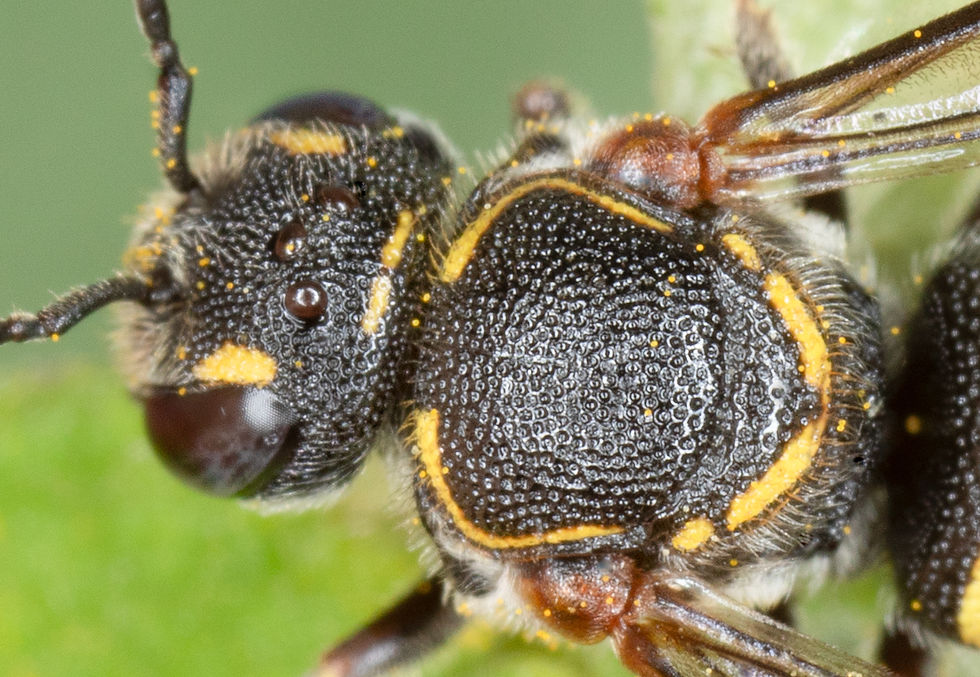
The head and thorax of Stelis cuckoo bees are typically heavily pitted.

The bees' abdomens are also coarsely pitted.
Louisiana Painted-dark Bee
Stelis louisae
(Subgenus Dolichostelis)
Size: 8 mm (female & male)
The Louisiana painted dark bee (Stelis louisae) is widespread throughout the eastern half of the United States: it occurs along the Atlantic coast from Maine to Florida, and it ranges as far west as east Texas and Nebraska.
Stelis louisae belongs to the subgenus Dolichostelis. Members of this subgenus usually target members of the resin bee subgenus Megachile (Chelostomoidies). Louisiana painted dark bees invade the nest of the bellflower resin bee, Megachile (Chelostomoides) campanulae.
Stelis louisiae Behavior
Most Stelis enter their hosts’ nests while the hosts are still in the process of building and provisioning their egg chambers, before the cells are sealed. Bees of the subgenus Stelis (Dolichostelis), however, are “closed-cell parasites,” that is, they break into their hosts’ nests after the egg chambers are sealed.
According to Charles D. Michener's The Bees of the World, Stelis louisae cuckoos steal into resin bee nests after removing the resin seals the host bees cement onto the entrances of their egg chambers. Once inside the nests, the Stelis louisae adults destroy the host eggs or larvae and lay their own eggs in the hijacked chambers. Upon leaving their hosts' nests, the cuckoos replace the entrances' resin seals.
Like all other cuckoo bees in this guide, Stelis louisae do not gather pollen and are not endowed with scopal brushes for carrying pollen. The bees do, however, sip nectar, and can be found foraging on sunflowers, wild indigo, mountain mint, fleabane, goldenrod and other flowers. The bees shown here were feeding on mountain mint (Pycnanthemum), Joe Pye weed (Eutrochium) and romerillo (Bidens alba).

A Stelis louisae cuckoo bee
Identification information: Bees of the subgenus Stelis (Dolichostelis) have a slender shape, and are black with pale or yellow markings and coarse punctures on their bodies. On both male and female Dolichostelis, the area between the antennae is short and somewhat protuberant.
Bees of the subgenus Dolichostelis can be identified by this trait (shown in the accompanying photo strip): the base of the propodeum is set off from the metanotum by a ridge and zone divided into a series of long pits. (The metanotum is the rearmost thorax segment, and the propodeum is directly behind it.)
Stelis louisae specifically have yellow face markings edging their compound eyes; yellow lines tracing the rims of their thoraxes; and yellow stripes banding their abdomens. The legs of Stelis louisae are reddish and their wings transparent brown. The reddish coloration of the bees' legs tends to be more pronounced in the bees' southern range. Males and females are very similar in appearance.
Stelis louisae can be distinguished from other Dolichostelis by the broken yellow line on the second abdominal segment (T2) as shown in the photo strip here. The yellow markings on Stelis louisae also tend to have an orangish tinge. Both females and males have broad yellow stripes along the inner rims of their compound eyes. On males, a thick yellow mark n the lower face connects the two stripes.

This is a female Stelis louisae (Louisiana painted dark bee).

Frontal view of a female Stelis louisiae

Face of a female Stelis louisae: on members of the subgenus Dolichostelis, the area between the antennae is short and somewhat protuberant.
RECOMMENDED REFERENCES - Stelis
Ascher, John S., & John Pickering. Species Descriptions and Keys for Stelis. Discover Life Bee Species Guide and World Checklist (Hymenoptera: Apidae: Anthophila). Discover Life.
Cockerell, T. D. A. 1911. Descriptions and records of bees.—XXXIV. Annals and Magazine of Natural History 7(39): 225-237.
Danforth, Bryan N., Robert L. Minckley, & John L. Neff. The Solitary Bees: Biology, Evolution, Conservation. Princeton: Princeton University Press, 2019.
Graenicher, S. 1928. On the bees of Miami, Florida. Florida Entomologist 12(2): 27-32.
Michener, Charles D. 2007. The Bees of the World (2nd ed.). Johns Hopkins University Press, Baltimore and London, 953 pp.
Michener, Charles D. 1955. Some biological observations on Hoplitis pilosifrons and Stelis lateralis (Hymenoptera, Megachilidae). Journal of the Kansas Entomological Society 283:81-87.
Mitchell, Theodore B. 1962. Bees of the Eastern United States. Vol. 2. North Carolina Agricultural Experimental Station Technical Bulletin No. 152.
Neff, John L. 2021. Megachile sculpturalis, a novel host for the cuckoo bee Stelis costalis (Hymenoptera: Megachilidae). Journal of the Kansas Entomological Society 93: 3 (4): 349–353.
Parker, Frank D., James H. Cane, G.W. Frankie, & S. Bradleigh Vinson. 1987. Host records and nest entry by Dolichostelis, a kleptoparasitic anthidiine bee. Pan-Pacific Entomologist 63:172-177.
Parker Frank D., & George E. Bohart. 1979). Dolichostelis, a new genus of parasitic bees. Journal of the Kansas Entomological Society 52: 138–153.
Pascarella, John B., & H. Glenn Hall. "The Bees of Florida." Department of Entomology & Nematology Department, University of Florida. Web. May 24, 2015. <hhttp://entnemdept.ufl.edu/HallG/Melitto/floridabees/Bees_of_Florida_Part1.pdf>
“Stelis”. Exotic Bee ID. USDA APHIS Identification Technology Program (ITP) and Utah State University. Fort Collins, Colorado. https://idtools.org/exotic_bee/index.cfm?packageID=1181&entityID=8993
Urban, Danuncia, & Daniele R. Parizotto. 2012. A revised key to the Neotropical cleptoparasitic anthidiine genera (Hymenoptera, Megachilinae) with notes and description of the male of Rhynostelis Moure & Urban. Zookeys 2012 (249): 27-35.