SHARP-EATMAN
NATURE
PHOTOGRAPHY
ID GUIDE TO WILD BEES of NEW YORK

GREEN SWEAT BEES
Augochlora, Augochloropsis & Augochlorella
GREEN SWEAT BEES
Tribe Augochlorini
Genus: Augochlora, Augochlorella & Augochloropsis
The Greek prefix augochlor- means "intense gold- green". According to Charles D. Michener’s The Social Behavior of the Bees, the tribe Augochlorini consists of bees that are typically brilliant green -- but sometimes purple, blue, brassy, red or black. Augochlorini are found predominantly in Central and South America and number more than 40 genera and more than 660 species. Nonetheless, in most of the continental United States and Canada, there are only 3 genera, divided into approximately 30 species -- Augochlora, Augochlorella, and Augochloropsis.
Traits of Augochlorini. Bees of the tribe Augochlorini can be recognized by two characteristics, among others: they are iridescent and usually green, and they have kidney-shaped compound eyes that are notched on the inner margin. All Augochlorini also possess two minute traits, visible under high magnification: (1) the hind tibiae are shorter than the combined tarsal segments of the lower leg; and (2) the bee's fifth tergum (5th upper abdomen segment) is notched.
Bees of the Augochlorini tribe are often solitary, but they also range from communal to semi-social. They tend to build nests in soil or, less commonly, in rotted wood. Some form large aggregations, constructing ground nests in clumps linked together by underground passages or rootlets.
Genus identification. Bees of the three genera Augochlora, Augochlorella and Augochloropsis are often confused with one another. Augochloropsis are also often misidentified as Agapostemon, a genus of large green striped sweat bees featured in this guide's preceding section. Tips for differentiating among these genera are detailed here.
Augochlora vs. Augochorella:
Augochlora and Augochlorella can be best told apart by examining differences in the forewings, and in head and facial structure. The features below are illustrated in the accompanying photo strip.
(1) Size: In the eastern United States, Augochlora are usuaully about 8 mm long, while Augochlorella typically range between 5.5 and 7 mm. (Two species found in the western United States - S. pomoniella and A. neglectula - may be as large as 8-9 mm.) Accordingly, within the eastern United States, green sweat bees in the smaller range (5.5 - 6.5 mm) are probably Augochlorella; those in the larger range (8 mm and above) are more likely to be Augochlora.
(2) Forewings: On the Augochlora forewing, the tip of the marginal cell is blunt or somewhat rounded, and it is pulled away from the margin of the cell. On the Augochlorella forewing, the marginal cell's tip is pointed and lies along the edge of the wing.
(3) Cheek and Vertex: The bee's cheek is the area behind the compound eye. The vertex is the top of the bee's head, right behind the small simple eyes called ocelli. On an Augochlora, the cheek and vertex are both fairly broad. On an Augochlorella, the cheek and vertex are narrow.
(4) Facial structure of females: The part of a bee's lower face directly above the mandibles is called the clypeus. On Augochlora females, the "parocular area" -- the face part directly above the clypeus and edging the inner compound eyes -- intrudes downward into the clypeus. The female Augochlorella lacks this trait. This trait is difficult to capture in field photographs but, when visible, it is an excellent way to identify the female Augochlora with certainty.
(5) Mandibles of females: The mandibles of female Augochlora are bidentate -- that is, each side of the mandibles terminates in a tip that forks into two pointed teeth. (The teeth are close in size, although the upper tooth is somewhat shorter.) By contrast, Augochlorella mandibles are sometimes described as "mitten-shaped." The mandibles terminate in tips that are broadly rounded lobes. A second set of small, rounded teeth project thumblike just short of the tips.
(6) Nesting Behavior: Augochlora pura nest in wood, while North American Augochlorella nest in the ground. Thus, if you find green bees emerging from nest holes in the ground, you probably should rule out Augochlora -- and conversely, if you encounter a green iridescent bee nesting in a rotted log, it is likely to be an Augochlora and not Augochlorella. (Note that ground-dwelling green bees might also be Augochloropsis or Agapostemon.)
GENERAL TRAITS OF THE TRIBE AUGOCHLORINI

Augochlorini are brilliantly iridescent, usually green bees.

Augochlororini may be brilliant blue green --

Or golden green --

A female Augochlora pura

A female Augochlorella aurata

A female Augochloropsis
AUGOCHLORA OR AUGOCHLORELLA?
Augochloropsis vs. Augochlora & Augochlorella
All Augochloropsis of the continental United States and Canada belong to the subgenus Paraugochloropsis. Augochloropsis of this North American region can be distinguished from Augochlora and Augochlorella of the same region by these traits:
(1) Tegulae. Tegulae are the plates where the wings join the thorax. On all Augochloropsis, the tegulae are D-shaped and mostly iridescent green. By contrast, on Augochlora, the tegula are oval and brown; on Augochlorella, they are roughly oval and yellowish-brown or pinkish brown.
(2) Legs. All three bee genera have some upper leg segments that may be partly iridescent green. On Augochloropsis, however, the first through fourth segments (from the top down, including the tibia), are brilliant iridescent green on all six legs. In addition, on males, the basitarsus (the segment directly below the tibia) is white on all six legs. These leg attributes distinguish Augochloropsis from all Augochlora and Augochlorella.
The iridescence of Augochloropsis tegulae and legs can be perceived by the naked eye, and thus serve as an excellent means of identifying these bees in the field.
Other traits: These are a few subtler traits that help separate Augochloropsis from Augochlora and Augochlorella. (1) Abdomen shape: the Augochloropsis abdomen is fairly uniformly broad and round. This aids particularly in distinguishing male Augochloropsis from male Augochlora pura and male Augochlorella, which tend to have narrow abdomens. (2) Hind leg of female: the leg spur on the hind tibia of the female Augochloropsis is comb-like. (3) Sternum of male: On male Augochloropsis, the fourth segment of the sternum (S4) has a median point. Male Augochlora and Augochlorella lack this trait. (On male Augochlora, the apical rim of S4 is straight. On male Augochlorella, S4 is somewhat curved to markedly curved.)
Augochloropsis vs. Agapostemon
Augochloropsis run larger than Augochlora pura and regional Augochorella. Eastern Augochloropsis species also tend to be predictably green rather than other iridescent colors, and to have light-green eyes mottled with black -- traits shared by Agapostemon. For all of these reasons, within our area, Augochloropsis are often confused with the large green iridescent bees of the genus Agapostemon, shown in this guide's next section.
Male Agapostemon can be easily differentiated from Augochloropsis because the former have striped abdomens -- no Augochloropsis have this trait. Female Agapostemon sometimes have striped abdomens -- but they are more often entirely green, like both genders of Augochloropsis.
The following traits help determine whether a large green iridescent bee of our region is an Augochloropsis vs. an Agapostemon:
(1) Size: Agapostemon are generally larger than Augochloropsis. Female Augochloropsis are typically 8-11 mm. Agapostemon of the eastern United States are typically 9-15 mm.
(2) Legs: As noted above, leg segments of Augochloropsis are iridescent green from the uppermost segment to the tibia. By contrast, the legs of female Agapostemon of the northeastern United States are mostly darkly-colored. The legs of male Agapostemon are yellow or mostly yellow.
(3) Face: Both male and female Augochloropsis have faces that are predominantly iridescent green, and black mandibles. By contrast, regional female Agapostemon have mandibles that are muddy greenish-yellow at the base. The mandibles of males have extensive yellow markings on the face. Eyes: The eyes of Augochloropsis are distinctly kidney-shaped, with an indentation on the inner rim. On Agapostemon, the indentation on the rim is subtler, so that the eyes appear less kidney-shaped.

This photo strip shows the differences between Augochlora and Augochlorella green sweat bees.
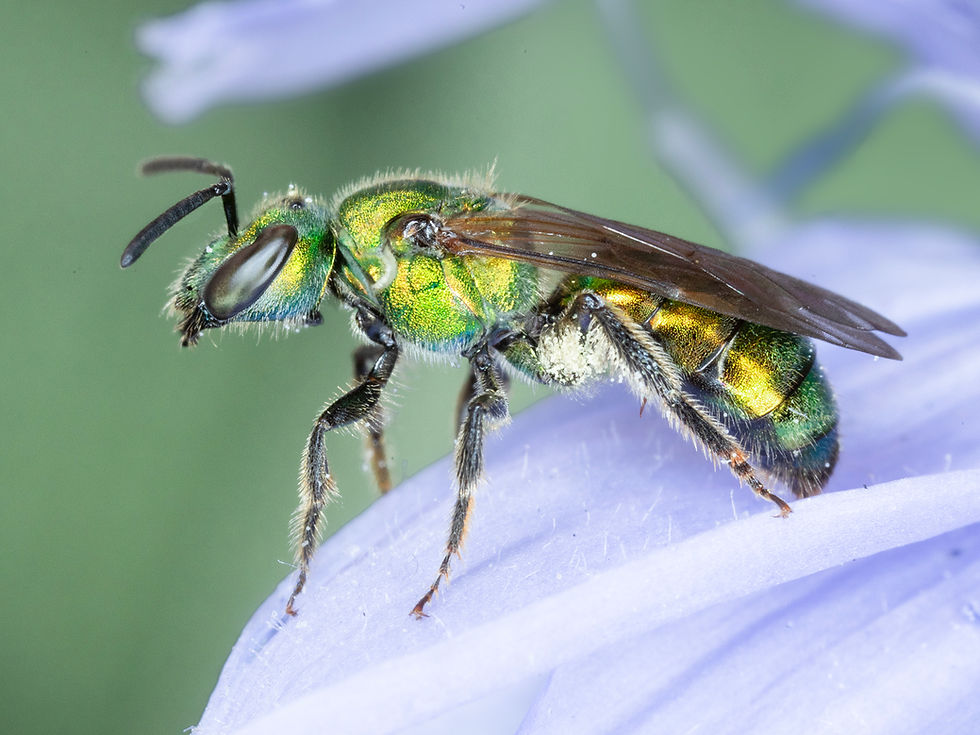
This is a female Augochlora.

This is a female Augochlorella.
AUGOCHLOROPSIS
vs. Augochlora & Augochlorella

This photo strip describes ways to tell Augochlopsis from Augochlora and Augochlorella.

LEGS (Augochloropsis): This is a female Augochloropsis. All legs of Augocloropsis are iridescent green from the top segment down to the tibia (the 4th leg segment). This trait distinguishes Augochloropsis from all Augochlora and Augochlorella. (On female Augochloropsis, the lower leg segments are mostly dark with reddish feet.)

LEGS (Augochloropsis): This is a male Auchloropsis metallica. Its legs are also iridescent green from the top segment through the tibia. The basitarsi on all legs are white. Each of these traits distinguishes the male Augochloropsis from male Augochlora and Augochlorella.
AUGOCHLOROPSIS
vs. Agapostemon

This is a male Agapostemon: male Agapostemon have striped abdomens, and legs that are mostly or partly yellow. These traits distinguish them from all regional Augochloropsis (as well as Augochlora and Augochlorella).

This is a female Agapostemon. Most female Agapostemon do not have striped abdomens. Instead, both their heads and bodies are predominantly iridescent green. Females have dark legs covered with fine hairs.
LEGS: This is a female Augochloropsis (Paraugochloropsis). Augochloropsis also have heads and bodies that are predominantly iridescent green. All regional Augochloropsis, however, have legs that are iridescent green from the top segment through the tibia. This trait separates them from all northeastern female Agapostemon.
Taxonomy of Augochlorini
(Green Sweat Bees)
Order: Hymenoptera
Family: Halictidae (Sweat Bees)
Subfamily: Halictinae
Tribe: Augochlorini
Species shown below:
Genus: Augochlora
Subgenus: Augochlora
Species: Augochlora pura
(Pure green sweat bee)
Genus: Augochlorella
Species: Augochlorella aurata
(Golden green sweat bee)
Genus: Augochloropsis
Subgenus: Paraugochloropsis
Species: Augochloropsis viridula
(Northeastern sweat bee)
GREEN SWEAT BEE SPECIES OF NEW YORK
Pure Green Sweat Bee
Augochlora pura
Size: 8 mm (female)
6-8 mm (male)
The pure green sweat bee (Augochlora pura) is the only species of its genus in the eastern United States. Augochlora pura are iridescent bees that typically have brilliant green heads, thoraxes, and abdomens. Some individual specimens may be golden-green, coppery, or coppery pink. Males and females have smoky-brown wings. Females have hairy legs and carry pollen on scopae located on their upper hind tibiae.
Augochlora heads are roughly hexagonal, with dark green compound eyes, black antennae and dark, brownish-black mandibles. On all Augochlora, the cheek and vertex are broad. (The cheek is located behind the compound eye, and the vertex is located on the top of the head, behind the three small simple eyes called ocelli). All female Augochlora have mandibles that terminate in two-toothed points. Males have simple mandibles that teminate in single points.
The legs of Augochlora pura look largely black to the naked eye. Under close inspection, on both males and females, the uppermost leg segments (coxae) are partly iridescent green; the trochanters and femurs (2nd & 3rd segments) are brownish black mixed with dark iridescent green; and the tibia (4th segment) is brownish black with faint dark iridescence. On females, the lower legs (basitarsi and tarsi) are brownish black to very dark red-brown. On males, the basitarsi are yellowish red on the forelegs and reddish brown on the middle and hind legs; the tarsi are reddish brown.
General traits that distinguish Augochlora pura from similar green sweat bees such as Augochlorella aurata (shown below) are detailed in the introduction to this guide page.
Behavior: Augochlora pura are solitary bees that prefer woodland areas and build nests under bark in rotting trees. They cobble their nests together using bits of dirt and debris found under the bark. The female in the accompanying photos was discovered racing in and out of tunnels and holes in a fallen log near a Rockefeller State Park trail. Dozens of other Augochlora pura nested around her in the same log, looking like living emeralds scurrying in and out of the bark.
Augochlora pura emerge in early spring in southern New York, feeding on pollen from blossoming maple trees. Pure green sweat bees become highly visible in Rockefeller State Park in May, pollinating spring wildflowers and the tree peonies in the park's Peony Monument garden. In the summer, the bees can be seen visiting orange butterfly milkweed, wild phlox, and goldenrod in sunny areas along park trails; mobbing the flowers of black locust trees in abutting woods; and gathering pollen from squash and garden flowers in Stone Barns' vegetable and flower gardens. Augochlora pura continue to pollinate the park's late-blooming asters and goldenrod through mid-fall.
BEST FIELD IDENTIFICATION TRAITS: Augochlora
Broad vertex & cheek
Oval brown tegulae
Marginal cell tip blunt or rounded
Mandibles of females forked, with two pointed tips
No yellow markings on face.
Upper legs are blackish brown with dark iridescence.
Males' lower legs are and yellowish-red to reddish-brown.
Found nesting in wood, such as rotted logs
Most likely to be confused w/ Augochlorella

A female pure green sweat bee (Augochlora pura )

A male pure green sweat bee (Augochlora pura )

An Augochlora pura emerging from under the bark of a fallen tree
FEMALE BEE
A female Augochlora pura: pure green sweat bees have iridescent (usually green) heads, thoraxes and abdomens. Females' legs are largely brownish black. (The upper leg segments are darkly iridescent.)

Lateral view of the thorax of a female Augochlora pura: note the wide cheek -- wider than the compound eye. (The cheek is the area behind the compound eye.)

Dorsal view of a female Augochlora pura.
MALE BEE

A male Augochlora pura drinking nectar from an onion flower

Alternate view of bee.

A male Augochlora: like females, males have iridescent heads and bodies. Males may be all green or have coppery highlight like this bee.
Golden-green Sweat Bee
Augochlorella aurata
Size: 5.5-7 mm
Golden-green sweat bees (Augochlorella aurata) tend to be smaller than the other green sweat bees shown on this page. Despite their name, golden-green sweat bees show considerable variation in color - ranging from pure green to yellow-green to coppery pink. The bees' upper legs are partly iridescent. On females, the tibia and lower legs are brown and covered with hairs. On males, the tibia and lower legs are multicolored with brown, reddish-brown and and reddish yellow. The wings of males and females are glassy with reddish brown veins. The tegulae (plates where the wings meet the thorax) are roughly oval and yellowish-brown or pinkish brown.
Identifying Traits: The introduction to this guide page provides a detailed comparison of the minute traits of Augochlorella that distinguish them from Augochlora and Augochloropsis. The bees' generally smaller size and tendency to brilliant color variations can be helpful clues for identifying them in the field. Among others, two distinctive traits of this species include the head's narrow vertex, and the bee's forewing structure. The tip of the marginal cell of an Augochlorella aurata forewing is pointed and lies along the edge of the wing. The these traits are shown in the accompanying photo strips.
Behavior: Augochlorella aurata are broad generalist pollinators that visit a seemingly endless range of wildflowers. In southern New York, they are likely to be spotted foraging on dogbane, fleabane, mountain mint, wild roses, and goldenrod. Augochlorella are also common pollinators of crops, such as apples, caneberries, carrots, strawberries, tomatoes, and watermelons.
Augochlorella aurata nest in partly-bare areas of flat or gradually sloped ground. In his seminal work, The Social Behavior of the Bees, entomologist Charles D. Michener wrote extensively on the nesting behavior and life cycle of Augochlorella aurata (known then under the name Augochlorella striata). Michener noted the species' primitively eusocial behavior: they have a yearly life cycle split into spring and summer phases. In the first spring “foundress phase,” females bees work together to construct an underground nest and provision it for 6-8 male and female offspring. When the young emerge, the males leave the nest, never to return. The females remain in the nest as workers.
In the second phase, the original “foundress workers” cease working and the new workers take over and provision the nest for a second brood of 8-13 males and females called reproductives. When this second brood hatches in late summer, the males and females mate. The males die and the inseminated females overwinter. To stay warm, the females dig downward into the earth from the lowest parts of their nests. They emerge in spring to complete the colony’s life cycle.
Augochlorella aurata social behavior shows flexibility, however. The bees' nests are sometimes established by a single foundress that dies off during the worker phase, and which is replaced by a single “replacement queen” from the first brood. In such instances, orphaned colonies are considered “parasocial”. (Only colonies that retain the original queen throughout the second season are called “eusocial”.) Parasocial colonies allow for more diversity of genetic material in the hive.
Other Augochlorella species: Augochlorella aurata is the only Augochlorella species in New York and the majority of New England States. It appears in all states of the continental United States except for Arizona and California.
Six other Augochlorella species occur in the continental United States and Canada: Augochlorella bracteata, A. gratiosa, A. karankawa, A. neglectula, A. persimilis, and A. pomoniella.
Augochlorella persimilis is widespread in much of the eastern United States south of New England. Augochlorella gratiosa is found throughout the southeastern United States, from Maryland to Florida, and in Gulf states from Florida to Texas. Both species are distinguished from Augochlorella aurata by minute traits visible only under strong magnification, such as qualities of the propodeum (the body part located directly behind the thorax).
Augochlorella bracteata and A. neglectula are found predominantly in the Southwest and Texas. Augochlorella pomoniella is found in the Southwest and California. Augochlorella karankawa was first described in 2004 and has been documented only in Oklahoma and Texas.

A female Augochlorella aurata

A male Augochlorella aurata
FEMALE BEE

This is a female Augochlorella aurata found in Florida. This species occurs throughout the eastern United States. It is the only Augochlorella species of New York.

Alternate view of the female Augochlorella aurata. The bee's legs are mostly darkly colored and hairy. (The upper leg segments are somewhat iridescent.)
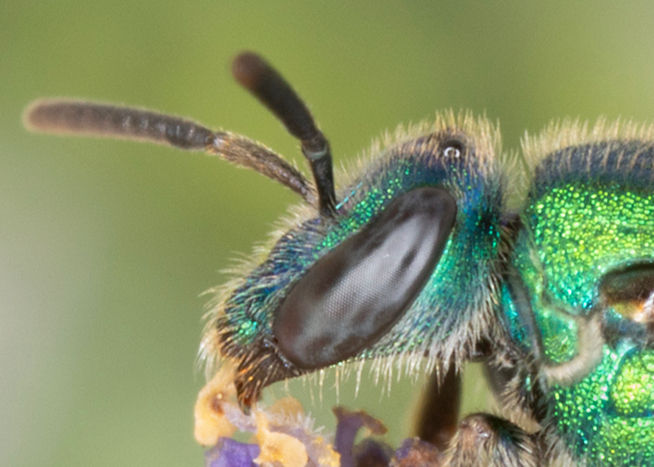
Note the narrow cheek (narrower than the compound eye).
MALE BEE

A male Augochlorella aurata

Dorsal view: note the narrow vertex. The trait distinguishes Augochlorella aurata from Autochlora pura. (The vertex is the top of the head behind the small eyes called ocelli.)

Lateral view of bee
BEST FIELD IDENTIFICATION TRAITS:
Augochlorella
Narrow vertex & cheek
Oval brown tegulae
Marginal cell tip pointed & flush with wing edge
Mandibles of females are "mitten-shaped,"
with rounded lobes on the tips.
No yellow markings on face.
Upper legs are dark brown with dark iridescence.
Males' tibiae and lower legs are reddish with dark markings.
Found nesting in ground
In the Northeastern United States, generally smaller than Augochlora & Augochloropsis
Most likely to be confused w/ Augochlora
Northeastern Sweat Bee
Augochloropsis viridula
Size: 9 mm
Augochloropsis are brilliantly iridescent bees, commonly green or blue-green. The abdomens of Augochloropsis are broad and round, giving them a more robust appearance than either Augochlora or Augochlorella. On all Augochloropsis, the tegulae (plates where the wings join the thorax) are D-shaped and largely iridescent.
All Augochloropsis of the United States and Canada belong to the subgenus Paraugochloropsis. On both male and female Augochloropsis (Paraugochloropsis), the upper legs are iridescent green from the coxae to the tibia (the lst to 4th segments). On females, the basitarsus (5th segment) on all six legs is dark-colored and covered with light and brownish hairs. On males the basitarsi are white on all six legs. The bees' largely iridescent legs and iridescent tegulae are visible to the naked eye and aid greatly in field identifications.
Both female and male Augochloropsis (Paraguochloropsis) have iridescent green faces without yellow markings. On female and male bees, the mandibles are darkly-colored. On males, the labrum (the face-part between the mandibles) is also darkly colored. Both males and females have blackish brown antennae and light-green eyes mottled with black spots.
Behavior: Augochloropsis may be solitary, communal, semisocial, or eusocial. They are typically generalist pollinators that visit a diverse gamut of flowering plants. Within the United States, they are key pollinators of wildflowers, and they are important pollinators of crops, among them blueberries, caneberries, melons and squash.
Species Identification: Augochloropsis are believed to have originated 16 million years ago and to have entered temperate North America 4 million years ago. Within the Western Hemisphere, there are now 4 subgenera and more than 140 species of Augochloropsis, most of them found in Central and South America. Only seven species are found within the continental United States and Canada.
As of now, the most up-to-date summary of the genus within the United States is a 2022 article by entomologists Zachary Portman, Mike Ardusher, Ian Lane and Daniel Cariveau. Prior to this work, Augochloropsis metallica (the green metallic bee) was considered the chief Augochloropsis species of New York. This species was divided into subspecies.
In 2022, Portman et al. elevated one of those subspecies to species status, naming it Augochloropsis viridula. Many northeastern Augochloropsis specimens formerly labelled Augochloropsis metallica have now been reclassified as Augochloropsis viridula.
Augochloropsis viridula and A. metallica
Augochloropsis metallica and A. viridula are very similar. Both are brightly iridescent green to blue-green bees with robust, round abdomens and glassy wings with brown veins. Both are medium-sized bees, usually around 9 mm. Both have iridescent green faces with dark mandibles, dark antennae and mottled green eyes. In both species, the bees' upper legs are iridescent. The lower legs (basitarsi) of males are white, and those of females are dark and covered with pale hairs. The two species are distinguished by geography and by minute physical characteristics.
Geography: In popular databases such as iNaturalist, Augochloropsis viridula goes by the somewhat misleading common name "northeastern sweat bee". (Viridula means "greenish".) This species occurs in most of the eastern and Midwestern United States.
According to Portman et al. (2022), Augochloropsis viridula ranges from Ontario through New England and southward along the eastern seaboard, possibly as far south as Florida. The species' distribution extends westward through much of the country east of the Mississippi. Portman et al. (2022) examined A. viridula specimens found in Ontario and these states: Alabama, Arkansas, Georgia, Illinois, Indiana, Iowa, Kansas, Maine, Michigan, Minnesota, Mississippi, Missouri, New York, North Carolina, Tennessee, and Wisconsin. (The authors noted that A. viridula is found as well on the "extreme eastern margins" of Oklahoma, Kansas and Nebraska).
Augochloropsis metallica has a more extensive westward distribution than A. viridula. Augochloropsis metallica typically occurs from the New Jersey Pine Barrens south to Florida. It ranges as far west as South Dakota, Colorado, Texas and Nuevo Leon.
Augochloropis metallica is uncommon in the northeastern United States, although sporadic sightings have been reported in New England. New York Augochloropsis identified before 2022 as A. metallica are now generally deemed Augochloropsis viridula.
Physical traits: Augochloropsis metallica and A. viridula can be distinguished in part by minute traits of the abdomen.
Pale hairs T2: On A. metallica, the hairs forming a fringe or band on the rear rim of T2 (the second upper abdominal segment) are thickened and flattened on the central portion of the rim. On females, the hairs are close together and arranged like the teeth of a comb. (T1 has a wide fringe similar to that on T2, but this is often worn off in older specimens.)
To the naked eye, these attributes of A. metallica make the pale hair band of T2 look broader in the middle -- and also make the T2 band appear broader and thicker than any pale hair bands rimming abdominal segments behind T2.
On A. viridula, by contrast, the fringe of white hair on T2 appears uniformly narrow from side to side and about the same width as bands appearing on segments behind T2. These differences are illustrated in the accompanying photo strip.
Surface of T2: On A. viridula, the surface of T2 is shiny and highly reflective, with pits about 2-4 pit-widths apart. On A. metallica, the surface is often tessalate, and pits on T1 and T2 are more closely-spaced, about 1 pit width apart. These traits are detectable only under high magnification.
BEST FIELD IDENTIFICATION TRAITS:
Augochloropsis
Upper leg segments and tibiae are bright iridescent green.
Male has white lower legs.
Tegulae D-shaped, large & iridescent green
Abdomen robust, broad and rounded
No yellow markings on face.
Found nesting in ground
Most likely to be confused w/ female Agapostemon

A female Augochloropsis (Paraugochloropsis)

A male Augochloropsis (Paraugochloropsis) viridula from New York


A male Augochloropsis (Paraugochloropsis) metallica from Texas
AUGOCHLOROPSIS GENERALLY

Thisis a female Augochloropsis viridula. Augochlororopsis are robust, iridescent bees.

Augochloropsis of the United States are typically brilliant green or blue-green.

On female Augochloropsis of the United States, the leg segments on all four legs are iridescent green from the top segment to the tibia (the fourth leg segment). On females, the basitarsi (below the tibiae) are mostly dark and covered with hairs. The lowest tarsi are reddish brown..
AUGOCHLOROPSIS VIRIDULA

This is a male Augochloropsis viridula (northeastern sweat bee)

Lateral view of head and thorax of the male Augochloropsis viridula: note the long white hairs on the bee's cheek.
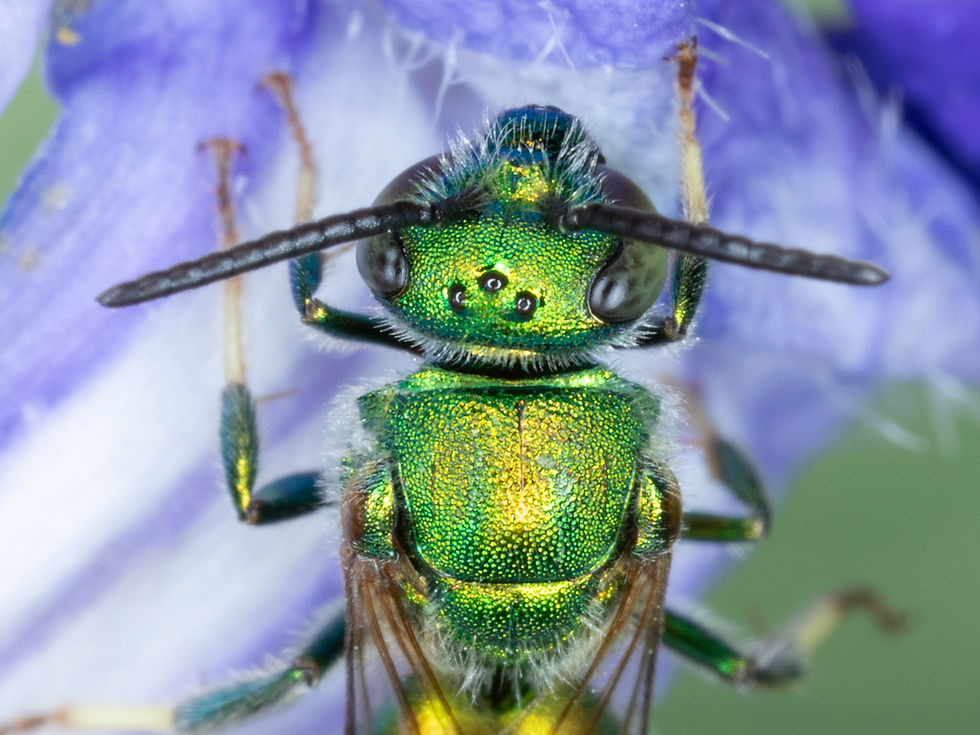
Dorsal view of abdomen: the tegulae are iridescent, and the front of the abdomen (pronotal ridge) flares out on either side.
FLORAL ASSOCIATIONS: Augochloropsis viridula
There is little organized data on the newly erected northeastern sweat bee (Augochloropsis viridula). Available, largely anecdotal, data suggests that Augochloropsis viridula is a broad generalist.
Since 2022, this species has appeared frequently on iNaturalist in association with small-flowered plants, among them mountain mint; Apiaceae such as dill, fennel and Queen Anne's lace; and Asteraceae such as goldenrod, dandelion, fleabane, romerillo and yarrow.
In describing the new species A. viridula, Portman et al. (2022) examined specimens that had been found in association with a diverse range of plants, among them caneberries, dogwood, false indigo, milkweeds, monarda, nightshades, sumac, sweet clover, wild geranium, wild roses and wild quinine. The Discover Life bee species guide and checklist notes that A. viridula is associated with bindweed.
RECOMMENDED REFERENCES - Augochlorini
Ascher, John S., & John Pickering. Species Descriptions and Keys for Augochlora, Augochloropsis and Augochlorella. Discover Life Bee Species Guide and World Checklist (Hymenoptera: Apidae: Anthophila). Discover Life.
Coelho, Beatriz W. T. 2004. A review of the bee genus Augochlorella (Hymenoptera: Halictidae: Augochlorini). Systematic Entomology 29: 282-323.
Eickwort, George C. 1969. A comparative morphological study and generic revision of the Augochlorine bees (Hymenoptera: Halictidae). The University of Kansas Science Bulletin 48: 326–524.
Engel, Michael S. 2000. Classification of the bee tribe Augochlorini (Hymenoptera: Halictidae). Bulletin of the American Museum of Natural History 250: 1–89.
Gibbs, Jason. 2017. Notes on the nests of Augochloropsis metallica fulgida and Megachile mucida in Central Michigan. The Great Lakes Entomologist 50 (1): 17–24.
Gonçalves, Rodrigo. 2016. A molecular and morphological phylogeny of the extant Augochlorini (Hymenoptera, Apoidea) with comments on implications for biogeography. Systematic Entomology 41(4): 700-712.
Michener, Charles D. 1974. The Social Behavior of the Bees: A Comparative Study. Belknap Press of Harvard University Press.
Michener Charles D. 2007. The Bees of the World. 2nd Ed. Johns Hopkins University Press, Baltimore, 953 pp.
Mitchell, Theodore B. 1960. Bees of the Eastern United States. North Carolina Agricultural Experiment Station Technical Bulletin No. 141.
Ordway Ellen. 1966. Systematics of the genus Augochlorella (Hymenoptera, Halictidae) North of Mexico. The University of Kansas Science Bulletin 56(16): 509-624.
Portman, Zachary, Mike Ardusher, Ian Lane & Daniel Cariveau. 2022. A review of the Augochloropsis (Hymenoptera, Halictidae) and keys to the shiny green Halictinae of the midwestern United States. ZooKeys 1130: 103-152.
Sandhouse, Grace A. 1937. The bees of the genera Augochlora, Augochloropsis, and Augochlorella (Hymenoptera; Apoidea) occurring in the United States. Journal of the Washington Academy of Sciences 27: 65–79.