SHARP-EATMAN
NATURE
PHOTOGRAPHY

STRIPED GREEN SWEAT BEES
Genus Agapostemon
Agapostemon are brilliantly-colored green bees that look like flying emeralds. They are generalist pollinators that visit a vast range of wildflowers, and they are key pollinators of many commercial crops -- among them alfalfa, apples, beets, berries, cotton, squash and sunflowers.
Agapostemon can be multivoltine -- that is, some species may produce more than one generation each year. In southern New York, Agapostemon fly from May through October and, depending on the species, may have one or two life cycles annually.
Agapostemon superficially resemble the iridescent green sweat bees of the tribe Augochlorini featured in this guide's next section. Nonetheless, differences in wing and leg structure, facial characteristics and evolutionary history have led to the placement of the genus Agapostemon in a different bee tribe. They form the subtribe known as the Caenohalictina within the tribe Halictini.
Traits of Agapostemon: All Agapostemon have iridescent green, blue-green or golden green heads and thoraxes. Their compound eyes are indented along the inner margin, making them appear somewhat kidney-shaped, and they are usually a striking light-green mottled by dark spots. Agapostemon are large for sweat bees --species of the Northeastern United States are typically 10-11 mm (2/5 in.); in the western United States, they may be as long as 15 mm (3/5 in.).
Agapostemon show pronounced sexual dimorphism. In most species, females' heads and bodies, including the abdomen, are iridescent green. In all Agapostemon species, males have striped abdomens: the stripes on the abdomens are part of the insect's integument (exoskeleton), and not formed by hairs. Males usually have black abdomens with bands that that are yellow or, less commonly, white or yellowish-brown.
In a few species, females' abdomens are banded like males' -- with brown, yellow or white stripes that are part of the integument. Alternately, females may have black abdomens that are banded by pale hairs -- an example is the bicolored agapostemon (Agapostemon virescens), shown here.
Male and female Agapostemon may differ in other ways as well. Female Agapostemon of our area have dark legs covered with short pale, yellowish or brown hairs. Their scopal hairs, located on the hind-leg tibiae and basitarsi, are relatively long. Males have predominantly yellow legs that are sparsely haired. Females' faces are mostly green, while males have extensive yellow markings on their faces.
All Agapostemon species share two minute traits, visible only under high magnification, which distinguish them from all other iridescent green sweat bees. These are shown in the accompanying photo strip. (1) The rear surface of the Agapostemon propodeum has a raised ridge. (The propodeum is right behind the thorax.) (2) The hind leg tarsi or "feet" of male Agapostemon are unique. Most male bees have five distinct segments, called tarsomeres, on the tips of their legs. The male Agapostemon has only four segments, a result of the first tarsomere being fused to the segment above it (the basitarsus).
The flight patterns of regional Agapostemon are also distinctive -- females and males tend to fly in jagged series of fast figure eights, and to come to rest on the tops of the flowers. By contrast, regional green sweat bees such as Augochlora pura, Augochlorella aurata and Augochloropsis metallica, tend to curl their bodies around flower parts and to hang from the sides of flowers.
Differentiating among Agapostemon species
Agapostemon are found only in the Western Hemisphere. There are more than 40 species of Agapostemon, most of them occurring in Central and South America. Fifteen species, representing two subgenera, are found within the continental United States and Canada. All Agapostemon of the northeastern United States belong to the subgenus Agapostemon (Agapostemon).
Three New York species are shown here: A. virescens, A. sericeus, and A. splendens. All three of these species are widespread -- they occur throughout the eastern and middle United States, from Canada to the Mexican border, and they range as far west as Utah and Oregon (but not California).
Female Agapostemon of varying species are usually differentiated by examining the following: facial characteristics; wing color; and the absence or presence and nature of hair bands on their abdomens. Females are also distinguished by minute traits invisible to the naked eye, such as the colors of hairs on their legs, and the patterns formed by pits and indentations on the bees' thoraxes.
Females of the three Agapostemon species shown here can be differentiated most easily by nesting habits, by wing color and by whether their abdomens are banded or entirely green.
Male Agapostemon of different species are told apart by such traits as the colors of their abdominal bands; their facial characteristics; the markings on their hind legs; and the markings on the sternum (the underside of the abdomen).
Males of the three Agapostemon species shown here are very similar in most respects, but can be told apart fairly easily by traits of the sternum and legs.
Striped Green Sweat Bee Behavior
Most Agapostemon build nests in the ground. Their nests consist of vertical tunnels and are usually kept well-hidden under leaves or other plant matter. They often plug their holes with pebbles, soil or plant debris while away from the nest foraging for pollen. Such plugs prevent soil or sand from slipping into their underground burrows and deter parasites such as cuckoo bees from entering the nest.
Some striped sweat bees, such as the bicolored and silky agapostemon shown below, nest in a variety of soils. Others are more selective -- the dark-winged agapostemon featured at the bottom of this page nests nearly exclusively in sandy soil, a trait that aids in its identification.
Agapostemon are usually solitary, with each female digging and provisioning her own burrow in which to lay eggs. Solitary nesting females often act gregariously, building in close proximity to one another in groups called aggregations. The silky and dark-winged agapostemon are both solitary nesters.
The bicolored agapostemon is an exception. Agapostemon virescens females are communal: although each individual bee builds and provisions her own eggs cells, multiple females share a single nest entrance and connecting tunnel. Such behavior saves labor by cutting down on tunnel entrance building and maintenance, and it also helps limit access by parasites and predators.

A female bicolored agapostemon (Agapostemon virescens)
TRAITS OF THE GENUS AGAPOSTEMON

This is a female Agapostemon. Most female Agapostemon have heads and bodies that are a brilliant iridescent green. Their legs are dark and covered with pale or brown hairs. Females carry pollen on their hind leg tibiae and basitarsi (4th & 5th leg segments).

This is a male Agapostemon: male Agapostemon have striped abdomens, and legs that are mostly or partly yellow. These traits distinguish them from all regional green sweat bees of the genera Augochloropsis, Augochlora and Augochlorella.

The compound eyes of Agapostemon are indented along the inner margin, making them look somewhat kidney shaped. Agapostemon compund eyes are typically light green mottled with dark spots.

Male Agapostemon of our area have extensive yellow markings on the clypeus (lower face) and mandibles. Their antennae are often partly golden brown. The scapes (lowest antennal segments) may be partly yellow.

Female Agapostemon of our region have faces that are entirely iridescent green. Their mandibles are black, usually with muddy yellow at the base. Their antennae are dark brown to black.
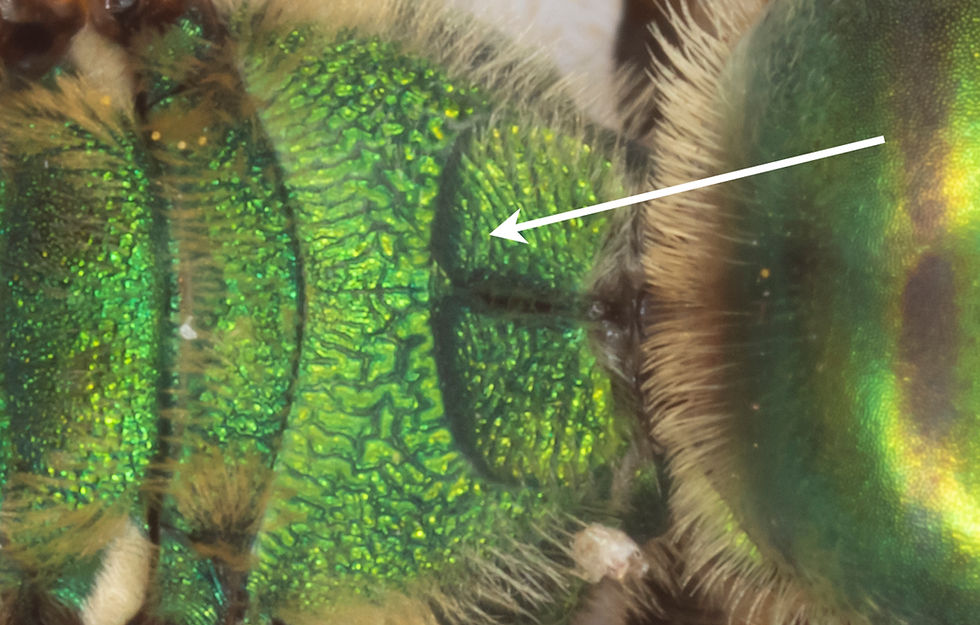
All Agapstemon have a ridge on the propodeum (located behind the thorax).
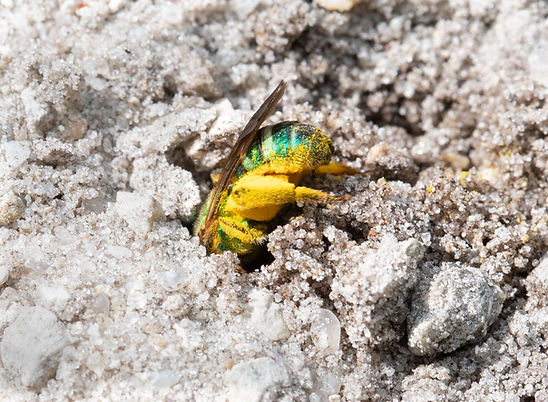
A female dark-winged Agapostemon nesting in sandy soil

A female Agapostemon splendens emerging from a nest in sandy soil

The female bee prepares to move the large pebble at left into the nest entrance in order to plug it.

Instead of lifting the pebble -- much heavier than the bee -- she comes up with an ingenious way to move it that won't require pushing or carrying it.
TAXONOMY OF AGAPOSTEMON
Order: Hymenoptera
Family: Halictidae (Sweat Bees)
Subfamily: Halictinae
Tribe: Halictini
Subtribe: Caenohalictina
Genus: Agapostemon
Subgenus (Agapostemon)
Species shown here:
Agapostemon sericeus (Silky agapostemon)
Agapostemon virescens (Bicolored agapostemon)
Agapostemon splendens (Dark-winged agapostemon)
Bicolored Agapostemon
Agapostemon virescens
Size: 10 mm (female)
11 mm (male)
Agapostemon virescens are jewel-like bees with metallic green heads and thoraxes and striped abdomens. They build nests consisting of deep vertical burrows in sloping soil and banks, and they keep their nests well-hidden under leaves and grass. In New York, bicolored agapostemon fly from mid-spring to late October, and they produce more than one generation each year.
As noted above, bicolored agapostemon are known to nest communally, with each female provisioning her own egg cells but sharing an entrance tunnel with other females. Bicolored Agapostemon work cooperatively; bees entering the nest carrying pollen are given right-of-way over those trying to leave, and multiple bees in the nest work to restore entrance holes as they crumble.
The bees' nests are usually protected by a guard bee that blocks the entrance with its head. This provides the bees' eggs and offspring with better protection against cuckoo bees and other predators than nests maintained by solitary bees. Sharing a nest entrance tunnel also allows for a division of labor that reduces the time and energy a female spends maintaining her burrow.
Plant-pollinator associations and nesting behavior
Bicolored agapostemon are broad generalist pollinators, known to frequent plants from more than thirty families --- they pollinate plants as diverse as cactus, hibiscus, evening primrose, irises, peas and strawberries. They are one of a handful of species of bees that feed on the nectar of native American white water lilies, which bloom in the park's Swan Lake during the summer.
Bicolored agapostemon are regionally closely associated with aster-family flowers. In early summer, they are often found on large composites such as sunflowers, coreopsis, coneflowers and New England asters; in late summer and fall, they appear on small-flowered Asteraceae such as goldenrod and Joe Pye weed. They also commonly visit mints such as oregano, bee balm and mountain mint.
Identifying Traits: Both male and female bicolored agapostemon have iridescent green heads and thoraxes and striped abdomens. Their wings are a light transparent brown with brown veins, and their tegulae are brown with a yellow mark in the front half.
Females: The female's abdomen is black and banded by highly visible bands of pale hairs. Agapostemon virescens is the only striped sweat bee species of the eastern United States with these combined traits. Thus the female of this species is easily identifiable.
Face: The female's eyes are light green mottled with black. The clypeus (face part above the mandibles) is iridescent green with a dark strip on the bottom. The mandibles are black with muddy yellow at the base. The antennae are brownish black.
Males: The male bicolored agapostemon has a black abdomen striped with yellow bands. Males have predominantly yellow legs with black markings and partly yellow faces.
Sternum: The best way to identify the male bicolored agapostemon is to examine the sternum (underside of the abdomen). As shown in the photo strip here, the sternum of the male bicolored agapostemon is typically mostly black or darkly-colored; in particular, S5-S6 (the fifth and sixth sternal segments) tend to be black or darkly colored. (S4 is also flat, rather than bulging at the rim, a trait not shared by A. sericeus or S. splendens.) The sternum is shown in the photographs here.
Face: The markings on the faces of males of all three Agapostemon species shown here are similar: on all, the apical (bottom) rim of the clypeus has a yellow band that comes to a peak in the middle; the bee's labrum is yellow; the mandibles are yellow, usually with dark tips; and the antennal scapes are yellow on the front. (The clypeus is the lower face-part above the mandibles; the labrum is the part directly below the clypeus; and the scape is the first, or bottom, antennal segment.)
Legs: Males have the following minute leg characteristics.
(1) The basitarsis lacks a ridge, a trait that distinguishes A. virescens from A. sericeus and A. splendens. This trait, however, may be difficult to see because it may be hidden behind hairs. (2) The inner hind tibia (the joint below the femur) is mostly yellow, sometimes with small amber or brown markings near the joints. These markings are small, and do not extend along the length of the tibia. (3) The hind femur of the male Agapostemon virescens has a tooth and is somewhat swollen (wider than the segments below it). It is mostly yellow, with brown markings on both ends, near the joints -- or only on the lower end, near the tibia. (The femur is the long, third leg segment). These traits of the hind femur are shared by males of the other two species shown on this page, but differentiate male Agapostemon virescens from species found in other regions. (4) The hind trochanter (the 2nd segment) is iridescent green.

A female bicolored agapostemon (Agapostemon virescens)

A male bicolored agapostemon (Agapostemon virescens)

A female bicolored agapostemon
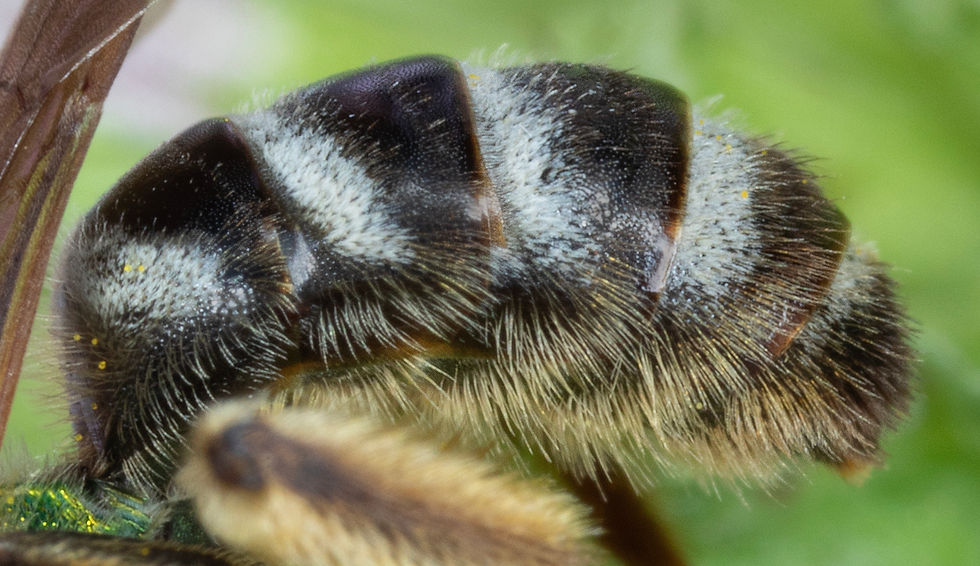
The broad white stripes on the female's abdomen are formed by pale hairs. By contrast, on the male Agapostemon virescens, the bands are part of the integument (exoskeleton).

Alternate view of female bee

A male bicolored Agapostemon: Males have iridescent green heads and thoraxes and banded abdomens. Their legs are yellow with black markings.

The abdomens of Agapostemon virescens males are black with yellow stripes. The stripes are part of the integument (exoskeleton) and not formed by hairs. [Photo © Copyright 2016 Julio Sharp]

The face of the male bicolored Agapostemon is yellow on these areas: the apical (bottom) rim of the clypeus sports a nearly triangular yellow spot that points upward; the mandibles are almost entirely yellow, with black tips and reddish areas in the middle; the labrum (face-part under the clypeus) is yellow; and the scapes (lst antennal segment) are yellow in front.
Silky Agapostemon
Agapostemon sericeus
Size: 10 mm (females)
10 mm (males)
These stunning, brilliant green bees pollinate a variety of fruit crops, including melons, apples, blueberries, cranberries and blackberries. They also visit a multitude of garden flowers and wildflowers, among them rhododendrons, catmint, asters, yarrow and goldenrod. In New York, silky agapostemon fly from May through September. In spring, silky agapostemon can be found pollinating the wild blackberries that abound in the park. In late spring and early summer, Agapostemon sericeus are avid visitors of orange milkweed and the vegetable and flower fields of Stone Barns.
Identifying Traits: Female and male silky agapostemon differ in the coloration of their abdomens, legs, and faces. The wings of both males and females are a glassy transparent brown with brown veins, and their tegulae are brown with a yellow mark in the front half.
Females: The head, thorax and abdomen of the female silky agapostemon are iridescent green. Their legs are dark and covered with pale, yellowish and brown hairs. Face: The female's eyes are light green mottled with black. The clypeus (face part above the mandibles) is iridescent green with a dark strip on the bottom. The mandibles are black with muddy yellow at the base.
Female Agapostemon sericeus can be distinguished easily from A. virescens, because the latter has a banded abdomen. Female A. sericeus can be told apart from A. splendens by the following: (1) WIngs: The wings of A. sericeus are a light transparent brown, while those of A. splendens are nearly opaque and the color of dark tea. (2) Prevalence and Nest habitat: The silky agapostemon is far more common in New York State than the dark-winged agapostemon and is not confined to sandy habitats for nesting.
Minute traits, visible under magnification, also help identify the female Agapostemon sericeus. (3) Thorax: The surface of the female's thorax looks rough and sandpapery. (4) Thorax: : The pronotal ridge (the collar like front part of the thorax) sticks out sharply from either side at a right angle to the thorax. (5) Hind legs: The hind leg scopal hairs of the female are long, silky and yellowish or golden..
Males: The male silky agapostemon runs somewhat smaller than male Agapostemon vierescens and A. splendens. Like males of those two species, however, the male Agapostemon sericeus has a black abdomen striped with yellow bands, yellow legs with black markings, and a partly yellow face and mandibles. The facial markings of the three Agapostemon species on this page are nearly identical.
Sternum: The easiest way to tell male Agapostemon sericeus apart from A. virescens and A. splendens is to examine the sternum (underside of the abdomen). The sternum of the silky Agapostemon is more extensively yellow -- most notably on the fifth and sixth sternal segments (S5-S6).
Agapostemon sericeus males also have specialized hairs on S4, but these are very difficult to see without considerable magnification. This trait, however, distinguishes A. sericeus from the other Agapostemon species on this page.
Legs: The basitarsis of the male silky agapostemon sometimes has a ridge that runs from the top joint 1/3 to 1/2 way along the segment -- or the segment may lack a ridge altogether. (1) The inner hind tibia (the joint below the femur) is mostly yellow, sometimes with small amber or brown markings near the joints. These markings sometimes extend along the inner leg and cover as much as 3/4 of the tibia (but do not form a continuous stripe along the entire length of the tibia). Where this occurs, this species can be differentiated from male A. virescens. (2) The hind femur of the male Agapostemon sericeus has a tooth and is somewhat swollen (wider than the segments below it). It is mostly yellow, with brown markings on both ends, near the joints -- or on the lower end, near the tibia. (The femur is the long, third leg segment).
Antennae: On the antennae of the male Agapostemon sericeus, F1 is proportionately small in comparison to F2. This trait helps differentiate male Agapostemon sericeus from males of numerous other species -- if you happen to have a magnifying glass handy, or you get a macro shot capturing details of the antennae. This trait is shown in the accompanying photo strip. (F1 and F2 are the third and fourth antennal segments from the bottom. They are situated right above the lowest segments, which are called the scape and pedicel.)

A silky agapostemon female

A silky agapostemon male

A female silky agapostemon (Agapostemon sericeus)

Face of female bee: the clypeus is brilliant iridescent green with a narrow dark strip on the bottom rim. The eyes are light green mottled with black, and the mandibles dark brown with yellowish areas at the base.

Lateral view of females's head and thorax

This is a male silky agapostemon (Agapostemon sericeus). Males of this species have green heads and thoraxes and yellow-and-black striped abdomens. This inidivdual bee has golden-green iridescence.

Lateral view of thorax

Alternate view of male Agapostemon sericeus
Nesting behavior of Agapostemon sericeus
Forty-five years ago, entomologist George C. Eickwort wrote that “nests of Agapostemon are usually widely scattered, inconspicuous, and virtually impossible to locate unless an observer is fortunate enough to see female bees entering them.” He was embarking on a study of the nesting habits of five Agapostemon species, one of which was the silky agapostemon. He had studied nests of Agapostemon sericeus for six years on the Cornell campus in Ithaca, New York.
Most nests were located in a secluded lawn surrounded by a garden. A few others appeared in a rarely mowed, weedy area near a heavily trafficked lawn, not far from an aggregation of Agapostemon virescens. Unlike A. virescens, the nest of A. sericeus were solitary – with each bee individually excavating her own burrow, provisioning it with pollen stores and laying eggs in her own individually constructed egg cells. All nests were dug in level or slightly sloping soil and well concealed by grass or other vegetation. The bees' soil choice varied greatly: they nested in both moist and dry earth, and in soil that varied from silty sand, to loamy soil to sticky clay.
The nest burrows consisted of long vertical tunnels, which led to short shafts connected to brood cells. The nests plunged as deep as 10 cm (4 in.), although Eickwort noted that some previous studies had revealed that A. sericeus nests could be as deep as 15 cm (6 in.) The bees’ nests were heavily parasitized by the cuckoo bee known as the articulated nomad bee (Nomada articulata). (This cuckoo bee is shown here accompanying photos of the female A. sericeus.)
In New York State, Agapostemon sericeus flies from July through October. According to Roberts (1969) and Eickwort (1981), A. sericeus is univoltine in New York state.
Dark-winged Agapostemon
Agapostemon splendens
Size: 10 mm (female)
11 mm (male)
This is a widespread species in the Northeastern United States, and it is found through much of New York. Nonethelss, the dark-winged Agapostemon usually nests in sandy soils, and it is most common in coastal areas or regions with sandy soil such as pine barrens. It is rarely reported in Westchester County; of the three species shown here, it is the single one that has not been documented previously in Rockefeller State Park.
Identifying Traits: Female and male dark-winged agapostemon differ in the coloration of their abdomens, legs and faces. Both male and female Agapostemon splendens have very dark brown wings, frequently described as being the color of strong tea. The tegulae of both males and females are brown with a yellow mark in the front half.
Females: The head, thorax and abdomen of the female dark-winged agapostemon are iridescent green. The female's legs are dark and covered with pale and brown hairs. Face: The females' eyes are usually light green mottled with black. The clypeus (face part above the mandibles) is iridescent green with a dark strip on the bottom. The mandibles are black with muddy yellow at the base. A color variation of this species occurs in which females have golden iridescent heads and thoraxes and gray eyes.
Females can be differentiated from female Agapostemon sericeus by these traits: (1) Wings: The wings of A. splendens are nearly opaque and the color dark tea, while those of A. sericeus are a light transparent brown. (2) Nest habitat: Silky agapostemon nest in a variety of soils, while dark-winged agapostemon nest almost exclusively in sandy soils. A female found nesting in loamy soil is probably not A. splendens.
Minute distinguishing traits of the dark-winged agapostemon female include: (3) Thorax: The thorax (scutum) of the female dark-winged agapostemon is finely textured, not rough. (4) Propodeum: The propodeum is located right behind the thorax; at its front margin is a wrinkled-looking, grooved strip. On the female A. splendens, a rough triangular shape is discernible in the center of the wrinkled strip. This detail is shown in the accompanying photo strip.
Males: The male dark-winged agapostemon can be difficult to differentiate with the naked eye from other species of the genus Agapostemon. The best way to distinguish it from males of the other two species shown here is by examining the sternum.
Sternum: The sternum of a dark-winged agapostemon is distinctly blacker than that of A. sericeus (especially on the fifth and sixth segments (S5 and S6). On A. splendens, S4 also has a distinct bulge on the rim; on A. virescens, S4 is flat.
Legs: (1) The basitarsis always has a ridge that runs from the top joint 1/3 to 1/2 way along the segment. (2) The inner hind tibia (the joint below the femur) is mostly yellow, sometimes with small amber or brown markings near the joints. These markings sometimes extend along the inner leg and cover as much as 3/4 of the tibia (but do not form a continuous stripe along the entire length of the tibia). Where this occurs, this species can be differentiated from male A. virescens. (2) The hind femur of the male Agapostemon sericeus has a tooth and is swollen (wider than the segments below it). Generally (but not always), this trait is more exaggerated than in either male A. sericeus or male A. virescens. (The femur is the long, third leg segment). (2) Each hind tibia (the joint below the femur) is mostly yellow, sometimes with brown or amber markings near the joints.
Agapostemon splendens nesting behavior
Agapostemon splendens are solitary, but often can be found in fairly large aggregations in the sandy areas where they nest. Photographs of a dark-winged agapostemon plugging its nest entrance are shown in the introduction at the top of this page.
In New York, dark-winged agapostemon are usually univoltine (producing only one generation per year). They emerge in summer, and fly from July through September. In warmer areas of southern New York, they may linger though October.

A dark-winged agapostemon female

A dark-winged agapostemon male (Agapostemon splendens)
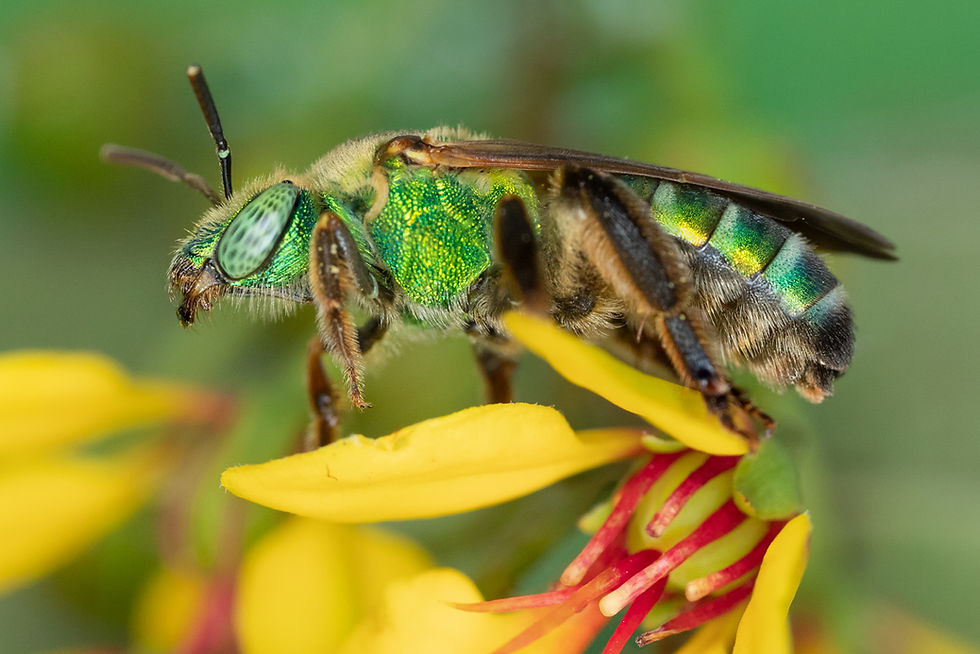
A female dark-winged agapostemon

The head, thorax and abdomen of the female dark-winged agapostemon are iridescent green.

The female's legs are dark and covered with pale and brown hairs.

This is a male dark-winged Agapostemon. The male has a green head and thorax and a black-and-yellow striped abdomen. Its legs are yellow with black markings.

Dorsal view of bee

The dark wings of this bee distinguish it from all other New York Agapostemon and eastern Agapostemon generally.
RECOMMENDED REFERENCES
Abrams, Judith & George C. Eickwort 1981. Nest switching and guarding by the communal sweat bee Agapostemon virescens (Hymenoptera: Halictidae) Insectes Sociaux. 28:105-116.
Abrams, Judith & Gordon C. Eickwort, G.C. 1980. Biology of the communal sweat bee Agapostemon virescens (Hymenoptera: Halictidae) in New York State. Search Agriculture. 1-20.
Ascher, John S. & John Pickering. 2022. Discover Life Bee Species Guide and World Checklist.
Cockerell, Theodore D. 1927. Bees of the genera Agapostemon and Augochlora in the collection of the California Academy of Sciences. Pan-Pacific Entomologist 3 (4): 153–162.
Crawford, James C. 1901. North American bees of the genus Agapostemon Guerin. Proceedings of the Nebraska Academy of Sciences 7: 156–165.
Dreisbach, Robert R. 1945. The green halictine bees of the genera Agapostemon, Augochlora, Augochlorella, and Augochloropsis (Hymenoptera: Apoidea) in Michigan, with keys and distribution. Papers of the Michigan Academy of Science, Arts and Letters 30: 221–227.
Eickwort, George C. 1981. Aspects of the nesting biology of five nearctic species of Agapostemon (Hymenoptera: Halictidae). Journal of the Kansas Entomological Society 54: 337-351.
Janjic, Jessica & Laurence Packer. 2003. Phylogeny of the bee genus Agapostemon (Hymenoptera: Halictidae). Systematic Entomology 28 (1): 101–124.
LaBerge, Wallace E & D. W. Ribble. 1966. The nests and larvae of two species of Agapostemon (Hymenoptera: Halictidae). Journal of the Kansas Entomological Society 39: 467-472.
Lovell, Harvey B. 1942. The bright green bees of the genera Agapostemon, Augochlora, Augochloropsis, and Augochlorella in Kentucky. Transactions of the Kentucky Academy of Science 10: 10-16.
Michener, Charles D. 2007. The Bees of the World. 2nd Edition. Johns Hopkins University Press, Baltimore, MD. 992 pp.
Mitchell, Theodore B. 1960. Bees of the Eastern United States. Volume 1. North Carolina Experiment Station Technical Bulletin. 538 pp.
Moure, Jesus S. & Paul D. Hurd. 1987. An Annotated Catalog of the Halictid Bees of the Western Hemisphere (Hymenoptera: Halictidae). Smithsonian Institution Press, Washington D.C.
Portman, Z.M., Mark Arduser M., I.G. Lane & Dustin P. Cariveau. 2022. A review of the Augochloropsis (Hymenoptera, Halictidae) and keys to the shiny green Halictinae of the midwestern United States. ZooKeys 1130: 103–152.
Portman, Zachary, Mark Arduser, Mike E. Powley, & Dustin P. Cariveau. 2024. Taxonomy of Agapostemon angelicus and the A. texanus species complex (Hymenoptera, Halictidae) in the United States. European Journal of Taxonomy 958: 203–241.
Ramírez-Freire, L., G.J. Alanís-Flores, R. Ayala-Barajas, H. Quiroz -Martínez & C.G. Velazco-Macías. 2012. Las abejas del género Agapostemon (Hymenoptera: Halictidae) del estado de Nuevo León, México. Revista Mexicana de Biodiversidad 83 (1): 63–72.
Roberts, Radclyffe B. 1973. Bees of Northwestern America: Agapostemon (Hymenoptera: Halictidae). Oregon State University Agricultural Experiment Station Technical Bulletin 126: 1–23.
Roberts, Radclyffe B. 1972. Revision of the bee genus Agapostemon (Hymenoptera: Halictidae). University of Kansas Science Bulletin 49 (1): 437–590.
Robertson, Charles. 1897. North American bees - Descriptions and synonyms. Transactions of the Academy of Science of St. Louis 7: 315–356.
Sandhouse Grace A. 1936. The bees of the genus Agapostemon (Hymenoptera: Apoidea) occurring in the United States. Journal of the Washington Academy of Sciences 26 (2): 70–83.
Sheffield Cory S., Lars Vilhelmsen & Frédérique Bakker. 2021. Taxonomy of the New World bee genus Agapostemon Guérin-Méneville – new names and synonymies (Hymenoptera: Halictidae). European Journal of Taxonomy 751: 1–23.