SHARP-EATMAN
NATURE
PHOTOGRAPHY

STRIPED GREEN SWEAT BEES
Tribe Caenohalictini - Genus Agapostemon
Agapostemon are brilliantly-colored green bees that look like flying emeralds. To the naked eye, bees of the genus Agapostemon may resemble the iridescent green bees of the Augochlorini tribe discussed in this guide's previous section. Nonetheless, differences in wing and leg structure, facial characteristics and evolutionary history have led to the placement of the genus Agapostemon in a different tribe known as the Caenohalictini.
Traits of the Genus Agapostemon
Agapostemon of the Northeastern United States tend to be larger than most green sweat bees of the tribe Augogochlorini. Agapostemon also often show pronounced sexual dimorphism: females may have predominantly iridescent green heads and bodies, while males are only partly green, with abdomens that have dark stripes alternating with yellow or pale stripes -- as exemplified by the silky agapostemon (Agapostemon sericeus). In other species, such as the bi-colored agapostemon (Agapostemon vierescens), both males and females have banded abdomens.
Male and female Agapostemon may differ in other ways as well. Female Agapostemon of the northeastern United States usually have dark legs covered with short pale hairs, while males have predominantly yellow legs. Females' faces are mostly green, while males have extensive yellow markings on their faces.
Striped Green Sweat Bee Behavior
Most Agapostemon are generalist pollinators that build nests in the ground. Their nests consist of vertical tunnels and are usually kept well-hidden under leaves or other plant matter. Agapostemon may be multivoltine -- that is, some species may produce more than one generation each year.
Agapostemon are often solitary, with each female provisioning her own nest -- although solitary nesting females may act gregariously, building in close proximity to one another. In some species, such as Agapostemon virescens, females are communal: multiple females share a single nest entrance and connecting tunnel, but each individual bee builds, provisions and lays eggs in her own eggs cells.
Differentiating among Agapostemon species
Male Agapostemon of different species are told apart by such traits as the colors of their abdominal bands; their facial characteristics; the markings on their hind legs; and markings on the sternum (the underside of the abdomen).
Female Agapostemon of varying species are usually differentiated by examining the the following: facial characteristics; wing color; and the colors of their abdomens (whether they are entirely green vs. striped, and if striped, by the colors of the stripes). In more challenging cases, females are distinguished by minute traits invisible to the naked eye, such as the colors of hairs on their legs, and the patterns formed by pits and indentations on the bees' thoraxes.

TAXONOMY OF NEW YORK AGAPOSTEMON
Order: Hymenoptera
Family: Halictidae (Sweat Bees)
Subfamily: Halictinae
Tribe: Caenohalictini
Genus: Agapostemon
Species shown here:
Agapostemon sericeus (silky agapostemon)
Agapostemon virescens (bi-colored agapostemon)
Bi-colored Agapostemon
Agapostemon virescens
Size: 2/5" (medium-small)
Agapostemon virescens are jewel-like bees with metallic green heads and thoraxes and striped abdomens. They build nests consisting of deep vertical burrows in sloping soil and banks, and they keep their nests well-hidden under leaves and grass. In New York, bi-colored agapostemon fly from mid-spring to late October, and they produce more than one generation each year.
As noted above, bicolored agapostemon are known to nest communally, with each female provisioning her own eggs cells but sharing an entrance tunnel with other females. Bicolored Agapostemon work cooperatively; bees entering the nest carrying pollen are given right-of-way over those trying to leave, and multiple bees in the nest work to restore entrance holes as they crumble.
The bees' nests are usually protected by a guard bee that blocks the entrance with its head. This provides the bees' eggs and offspring with better protection against cuckoo bees and other predators than nests maintained by solitary bees. Sharing a nest entrance tunnel also allows for a division of labor that reduces the time and energy a female spends maintaining her burrow.
Plant-pollinator associations
In New York, bi-colored agapostemon are common visitors to flower and vegetable gardens. In natural areas, they tend to appear in meadows and along sunny edges of woodland paths.
Bi-colored agapostemon are generalist pollinators, however, known to frequent plants from more than thirty families --- they pollinate plants as diverse as cactus, hibiscus, evening primrose, irises, peas and strawberries. They are one of a handful of species of bees that feed on the nectar of native American white water lilies, which bloom in the park's Swan Lake during the summer.
Bi-colored agapostemon are regionally closely associated with aster-family flowers. In early summer, they are often found on large composites such as sunflowers, coreopsis, coneflowers and New England asters; in late summer and fall, they appear on small-flowered Asteraceae such as goldenrod and Joe Pye weed. They also commonly visit mints such as oregano, bee balm and mountain mint.
Identifying Traits: Both male and female bicolored agapostemon have iridescent green heads and thoraxes.
Females: Females' abdomens are banded by white hairs, a trait that makes them easy to identify. This is the only Agapostemon species of the northeastern United States in which females have banded abdomens.
Males: The male b-colored agapostemon has a black abdomen striped with yellow bands, yellow legs with black markings, and partly yellow faces and mandibles. On males, the pale bands and yellow markings are part of the integument (exoskeleton) and not formed by hairs. Males also have predominantly yellow legs with black markings. The male's mandibles and face are also partly yellow.
The male biolored agapostemon may be tricky to differentiate from male agapostemon of other species.
Sternum: As with the silky agapostemon shown below, the best way to identify the male bicolored agapostemon is to examine the sternum (underside of the abdomen). As shown in the photo strip here, the sternum of the male bi-colored agapostemon is usually mostly black or darkly-colored; in particular, S5-S6 (the fifth and sixth sternal segments) tend to be black or darkly colored.
Legs: Males may also be differentiated by minute leg characteristics. (1) On male Agapostemon virescens, the hind-leg trochanter (the top segment) is iridescent green. (2) The the tibia that are entirely or nearly entirely yellow: any dark markings are near the leg joints. (2) The femur and tibia of the hind leg usually lack dark markings. By contrast, the male A. sericeus (and other Northeastern species such as A. texanus and A. splendens) have dark markings on the inner hind tibia. The femur is the long, third segment of the leg, and the tibia is the segment directly below it.

A bi-colored agapostemon female

A bi-colored agapostemon male

The abdomens of male bi-colored Agapostemons have yellow stripes. The stripes are part of the integument (exoskeleton) and not formed by hairs. [Photo © Copyright 2016 Julio Sharp]

A male bi-colored Agapostemon walking on a greenhouse window. Note that the last few segments on the end of the bee's sternum (the underside of its abdomen) are black. This trait helps distinguish this bee from other Agapostemon species.

A male bi-colored Agapostemon. Note the black markings on the bee's predominantly yellow legs. The markings form a distinctive pattern that helps distinguish males of this species from other Agapostemon. [Photo © Copyright 2016 Julio Sharp]

A female b-colored agapostemon
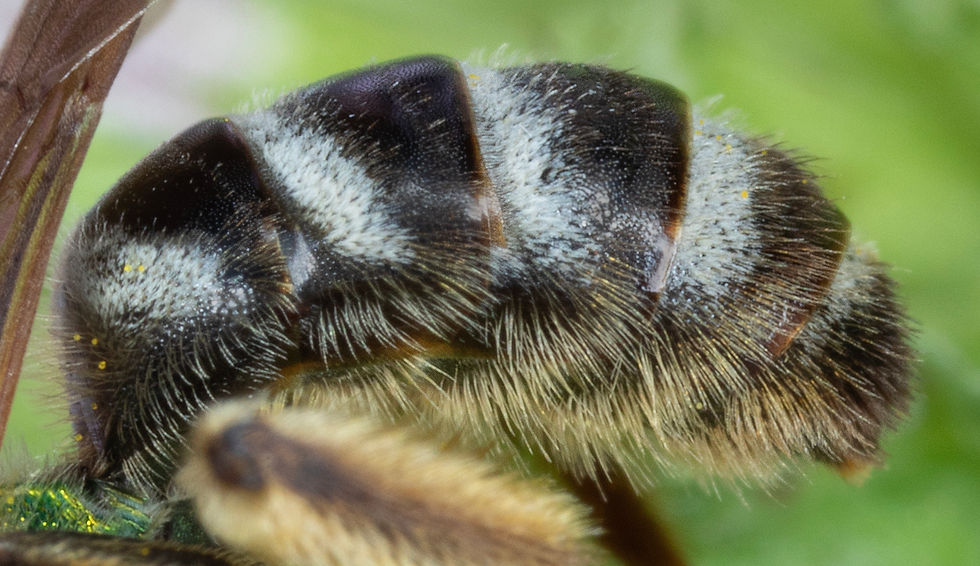
The white stripes on the female's abdomen are formed by pale hairs.

Alternate view of female bee
Silky Agapostemon
Agapostemon sericeus
Size: .4" - .45" (medium-small)
These stunning bees pollinate a variety of fruit crops, including melons, apples, blueberries, cranberries and blackberries. They also visit a multitude of garden flowers and wildflowers, among them rhododendrons, catmint, asters, yarrow and goldenrod. In early spring, these bees can be found pollinating the wild blackberries that abound in the park. In late spring and early summer, Agapostemon sericeus are avid visitors of orange milkweed in the gardens and fields of Stone Barns and the park.
Female Agapostemon sericeus are industrious pollinators. They are fast fliers and, when collecting pollen, they alight briefly on a flower before zipping on to the next. Females carry pollen on their hind legs. Males buzz around flowers, looking for mates; in the mornings, they often can be found resting in groups on plants.
The silky agapostemon is a solitary bee the nests in the ground. The nests of Agapostemon sericeus are known to be parasitized by the black-and-red cuckoo bee, Sphecodes prosphorus, which steals into the solitary silky Agapostemon nests and lays its own eggs there. When the cuckoo bee's eggs hatch, they kill off the Agapostemon young and eat the food stored for them.
Identifying Traits: The silky agapostemon has glassy wings, a trait that distinguishes it from the similar dark-winged agapostemon (Agapostemon splendens), which is also found in the Northeastern United States. The head, thorax and abdomen of the female silky agapostemon are iridescent yellowish-green. Females have dark legs covered with long pale-gold hairs. The male silky Agapostemons has a green head and thoraxes, but its abdomen is striped yellow-and black; the yellow stripes are part of the integument (exoskelton), and not formed by hairs. The male's legs are yellow with with black markings.
Females: Because they are entirely bright green, silky agapostemon females are often confused with the green metallic sweat bees of the Augochlorini tribe featured on the preceding guide page. Some traits that are helpful in distinguishing female silky Agapostemon are: (1) They are much heftier than the three green metallic bees shown below -- the silky Agapostemon abdomen is broader and bulkier, and its body is notably longer (nearly half an inch, compared to Augochlora pura at .31"; Augochlora metallica at .35"; and Augochorella aurata at .21"). (2) As shown in the photostrip at right, female silky Agapostemons thoraxes have a rough texture, and their abdomens have three white hairbands, the second of which tends to be the widest.
The Xerces Society's Guide to Attracting Native Pollinators notes that the easiest way to tell female Agapostemon from the similar Augochlora pura (shown on this guide's previous page) is to look at the rear of the thorax -- on the Agapostemon, this part is flat and edged by a curved ridge; on the Augochlora pura, by contrast, the rear of the thorax is rounded and ridgeless.
The flight pattern of the female silky Agapostemon is also distinctive -- a jagged series of fast figure eights -- and it tends to come to rest on the tops of the flowers. Augochlora pura and Augochloropsis metallica green sweat bees, by contrast, tend to curl their bodies around flower parts and to hang from below or from the sides of flowers.
Males: The male silky agapostemon can be difficult to differentiate with the naked eye from other species of the genus Agapostemon.
Sternum: The easiest way to tell male Agapostemon sericeus from male A. virescens (shown below) is to examine the sternum (underside of the abdomen): the sternum of a bi-colored agapostemon is distinctly blacker. By contrast, a male silky agapostemon has extensive yellow areas on sternum -- most notably, on the fifth and sixth sternal segments (S5-S6).
Legs: (1) Each hind femur of the male Agapostemon sericeus has a tooth and is mostly yellow, with brown markings near the bottom joint. (The femur is the long, third leg segment). (2) Each hind tibia (the joint below the femur) is mostly yellow, sometimes with small amber or brown markings near the joints.

A silky agapostemon female

A silky agapostemon male

A female silky Agapostemon

The female of this species is a brilliant iridescent green.

Dorsal view of a female silky agapostemon

This is a male silky agapostemon (Agapostemon sericeus). Males of this species have green heads and thoraxes and yellow-and-black striped abdomens.

Head of a male Agapostemon sericeus: the bee's mandibles, clypeus (face part above the mandibles) and labrum (face-part beneath the clypeus) are mostly yellow; so are the front faces of the antennal scapes (lowest antennae segments).

Dorsal view of male bee: most of the male's head, and all of its thorax, are bright iridescent green.
PHOTO CREDITS: All photos and text © Copyright 2014-2026 Paula Sharp and Ross Eatman, unless otherwise noted. All rights reserved. If you wish to use any of the photographs here for educational or other purposes, please read permissions page.
REFERENCES: For a comprehensive list of references used in compiling this guide, click here:
